We got the news yesterday that Margaret Cochran had passed away earlier this week. In a journey filled with inexplicable good fortune, my crossing paths with Margaret stands out as a highlight of my adult life.
Margaret was the first therapist I ever had, so I had no way of knowing that I had stumbled onto an A-list provider. Subsequent encounters, and stories I heard from others, clued me in that I had “fallen into the butter,” as my mother-in-law would have put it.
Margaret Cochran was a tiny woman, but you didn’t notice that. She always dressed magnificently, every detail, every accessory just so. Every hair in place. I’m not a fashionista so I don’t know all the right words, but visualize a fortune teller who shopped at Nordstrom.
I mean the “fortune teller” reference. Margaret wove nimbly between two worlds. There is the one that I, a software engineer, knew – things you can touch and see and hear. Then there’s the other world, that not all of us can see or sense. By the time Margaret was done with me, I was comfortable with the notion that there are things happening that I can’t sense, but they happen, nonetheless.
I’ll never forget sitting in her office one day. “Office” carries the wrong connotation – it was as gracious and beautiful as she was. We were sitting opposite each other in the comfortable chairs. But sitting next to Margaret, on the floor, was a cat. Silent. Motionless. Looking right at me.
“It’s a little disconcerting, the…, um…”
She raised an eyebrow. “My familiar?”
She said it, I didn’t.
The gift and its descendants
The details of what Margaret Cochran and I discussed are private, and ultimately unimportant. What’s important is how she changed my life and its trajectory.
Margaret taught me to be the sort of person that I wanted to be. She very likely held my new family together during the first chaotic couple of years. If you catch me being empathetic, Margaret Cochran has a lot of responsibility for that.
Now there’s a hole in the fabric of my life. I hadn’t spoken to Margaret in a decade, but it was heartwarming to know she was down there in the South Bay, doing relentless good for so many people. She always said they’d take her out of her office feet first, and as I understand the circumstances of her passing, that’s about what happened. For that I am grateful. But I didn’t think it would be so soon, and I hoped I would leave the planet safe in Margaret Cochran’s hands.
Truth is, it still is. Margaret would often talk about how we all are influenced by people who died before we were born. Imagine a great-grandparent who taught a lesson (for good or ill) to your grandmother, who sent it down to your dad, and here you are.
Margaret Cochran gave innumerable positive lessons and support to hundreds, perhaps thousands, of clients. I trust that those lessons will work their way through the generations. I know that my best self counts heavily on them, and I’ll do what I can to send them along.
I know that the Margaret-shaped hole in my life fabric won’t be mended, but I will learn to live with it, and be grateful that I spent some time in that comfortable chair.
Margaret had a phrase about stepping up to a challenge and doing the things that need to be done. So I’m going to put on my big-girl pants and get on with my life, sharing the lessons she gave me.
That world I can’t see, can’t sense – I hope Margaret Cochran is in it. Because I definitely miss her in this one.
It seems weird to write about something that is still going on. I usually about one-off events or thoughts I’ve had. I don’t have a lot of experience writing about something in which I’m currently involved.
But I was reflecting on my PokerStars days. It seemed like something extraordinary happened a couple of times a week, and I can remember thinking, “Man, when this is all over, I should write a book, or a blog, or something.” Of course, when it was all over, I’d forgotten half of the extraordinary things, and all of the details. I’m not making that mistake again.
Back in the Bay
Lisa and I moved back to the Bay Area in the summer of 2019. There were vital family reasons, but they aren’t relevant here. But the fact is that we were back after being away for most of 15 years. In those years, I kept thinking I’d end up in a band of some sort – after all, my stops included Asheville, NC and Nashville, TN, two music hotbeds. But somehow, it never clicked.
Shortly after I got back, I started picking with two lovely gentlemen in Alameda – Nick Khadder and Chris Quale. That’s a story in itself. Anyway, one thing led to another, and we started playing at a Berkeley restaurant called “Gather,” as the Alameda Mountain Ramblers. Which, if you’ve ever been to Alameda, California, you know what an absurdly great bluegrass band name that is. One of our regular players was my son, John Haupert, who wields a mean mandolin.
And man, the breakfasts we’d have afterwards were epic. Scrambled eggs, biscuits, roasted potatoes to die for. God, now I’m hungry.
Anyway, as will happen with people who have families and professions, sometimes one or more musicians wouldn’t be available. I ultimately created a rotating cast of musicians who would come to Gather and serenade the brunch-goers with bluegrass and adjacent music. It was a grand time – I was playing out with friends, getting a free breakfast, and getting paid for it. This last bit was vitally important so I could say, “Ya, I’m a semi-professional musician.”
Who’s that ringer?
I don’t remember all the details, but I recall that John and I were playing at Gather with mandolin/guitar wizard Mike Thompson. I said we were going to play a Norman Blake song, and a young woman in the front went, “Woo-hoo!” I mean, did you think I said, “Taylor Swift?” Norman Blake is an Americana hero, but he’s not a household name.
Shortly thereafter, I said, “We’re going to play this song, that was written by <songwriter’s name>.” Same woman says, “No – <this other person> wrote that song.”
Waaaaaait a minute. Is this some kind of secret audition/exam we’re doing?
Leah and Jeremy
At the set break, I asked Mike Thompson who these ringers were.
“Oh, do you not know them? That’s Leah Wollenberg and Jeremy Reinhard – she plays fiddle, he plays banjo, and they both sing.”
Obviously my first thought was to invite them to come up and sing one with us in the second set. Equally obviously, John panicked. John is a planner. I plan too, but when an opportunity such as this presents itself, I’m thinking, “What can go wrong?” John thinks, “What will go wrong?”
I also think, “If it goes wrong, at least we tried.”
They came up and sang a song with us. I don’t remember what it was, but what I do remember is that it sounded fine, and we all had a blast. Including John, despite his initial fears reservations. We made them stay for another song, which was also fun, and by then John was comfortable with the whole situation.
All I could think was, “Here we are, a guitar, mandolin, and bass player. And a banjo player and fiddler, both of whom sing, just wandered into our midst.”
I invited them to come and sit with us at our post-gig brunch. Maybe it was the roasted potatoes, but they were up for doing a gig together.
Critical Gig #1, 11/11/23
The next date on the books at Gather was November 11, 2023. We all showed up, as planned. What we didn’t plan was that both Leah and John were wearing merch from the Critical Role podcast, which is for Dungeons & Dragons (“D&D”) nerds.
They made an instant connection, and we had to drag them kicking and screaming back to the point that we were about to play a gig as a five-piece band, which we’d never done.
Honestly, though, my concern was misplaced. We retreated to a corner of the restaurant patio to run through a few tunes that could cause a hiccup (as compared to, say, Old Home Place or Gold Rush). We decided to try Ridge Road Gravel, a Norman Blake tune (Leah say, “Woo-hoo!”). I grabbed my phone halfway through…
I wanted this song to be much too long…
That, folks, was pretty much it. Right then, I knew we had something magical. Also, with the alignment of the Critical Role merch, I instantly had the band name, like it or not.
Jesse on guitar
Not too long after that gig, Mike said, with regret, that he wouldn’t be able to be a regular member of the band. He has significant family obligations – obviously those are way more important than going out to pick with friends and getting paid tens of dollars to do it.
We totally understood, but we were also disappointed. Mike is a sweet guitar player and fantastic company. We found ourselves in the unusual spot of trying to find a bluegrass guitar player. Thing is, in the bluegrass world, you can’t swing a banjo by its neck without hitting a guitar player – usually you’re looking for another instrumentalist. But there we were.
We immediately thought of Jesse Poteralski, with whom we’d picked on a number of occasions. We pitched the idea to Jesse, and he came and played a gig with us at Gather. Again, mighta been the biscuits and roasted potatoes, but he said yes!
Jesse didn’t know he’d be accompanying a nine-year-old fiddler
It was during Jesse’s tenure with us that we decided to audition for Vern’s Stage. Vern’s Stage is a special “amateurs only” stage at the California Bluegrass Association’s Father’s Day Festival.
We put together a video per the audition instructions, and submitted it. Then we waited.
One day, there was the email: “Vern’s Stage: congratulations!” I literally danced around the living room, and Lisa shrieked when I showed it to her.
The good news was that we had to put together a 35-minute set for Vern’s Stage, and had over six months to do it. The bad news was that Jesse decided to move to Grass Valley. This was more than a little ironic, because Grass Valley is where the Father’s Day Festival is. But it’s also 2.5 hours from the Bay Area, so it wasn’t practical for Jesse to be our guitar player.
We seemed to go through guitar players like Spinal Tap went through drummers. Though at least without the spontaneous combustion.
Back to where we started
The first name that popped into my head after Jesse bolted for the foothills was the very same guy who had invited me to pick when Lisa and I moved back to the Bay Area. Chris Quale. With Covid at its height, Chris and Nick Khadder graciously invited me to sit in their back yards and pick with them (once they confirmed that I was vaxed). Those firepit picking sessions were a huge bright spot in the darkness of the pandemic.
I asked Chris to go to coffee with me, and pitched the idea of him playing a gig with us at O’Riley’s in Haight, San Francisco after the first of the year. More irony: Chris is around professional bluegrass music, shows, and festivals all the time. That’s because his sons, Miles and Teo are half of Crying Uncle Bluegrass Band, a professional touring act. Chris acts as manager, booking agent, roadie, bus driver, chaperone, and band photographer. But he’s never gotten to be on stage.
We fixed that on January 5th, 2025.
Another Quale takes the stage
We had a total blast. With professional sound support and a real full-size stage, we felt like real rock stars. And we played pretty good too – at least the sound engineer said we did well.
Chris simply said, “That was so fun. I’ve never played on a real stage.” It was high time he did, and yes, it was so fun.
Turning up the volume
Along with a few gigs at Armistice Brewing in Richmond, and the aforementioned O’Riley’s, we had three very cool gigs over the spring/summer.
We got to play on Peter Thompson’s bluegrass radio show on KALW in San Francisco, thanks to Leah’s connections. The magic of that gig was that Peter’s wife is Kathy Kallick – a California bluegrass legend, and the songwriter of Call Me a Taxi, which is one of our showcase pieces.
We didn’t know it, but when we played that song on the radio show, Kathy was standing right outside the studio, waiting her turn to go on. She gushed over our performance and gave us all hugs as we left. Coolest thing ever.
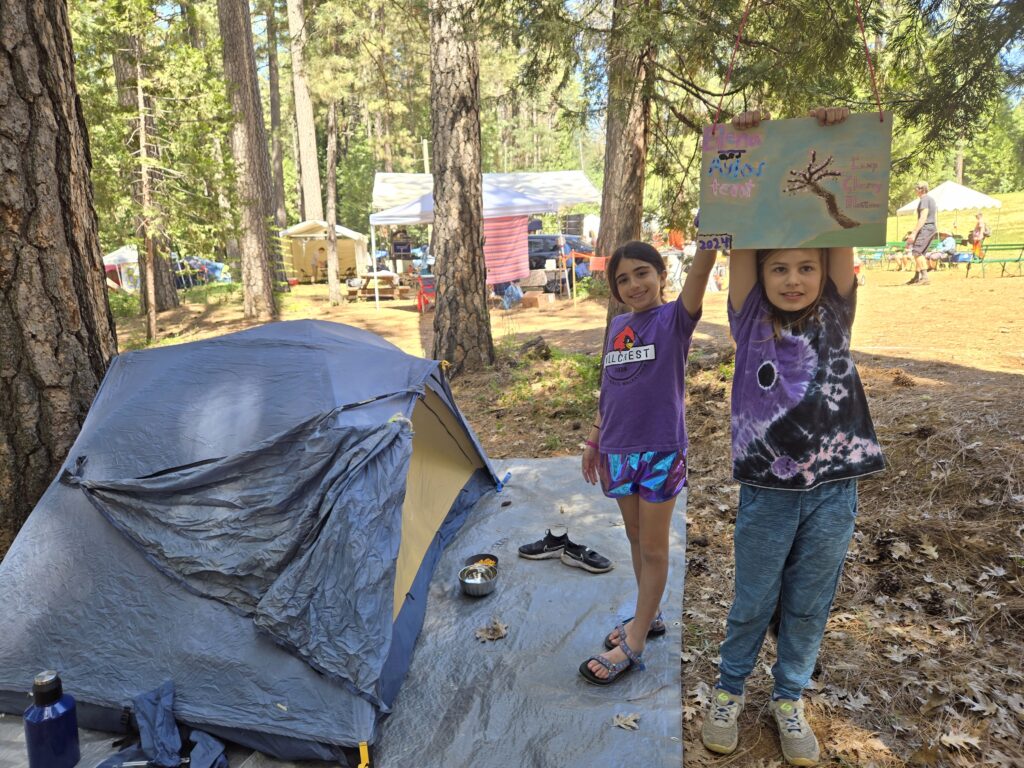
Our Vern’s Stage show at CBA was a big success. The whole family came up and camped, Elena went to “fiddle camp”, and we invited anybody we could find to eat tacos and burritos with us Saturday afternoon after our performance. Friends Shelly and Kevin brought their daughter Mina from Austin, Heather and Joe came out from San Jose – it was an amazing long weekend.
And honestly, none of this would have happened, except that our Vern’s Stage show gave everybody a great excuse to come out and party.
DaveC, Lisa, ElenaShelly’s T-shirts are the bombAll of the family, including Austin cousinsRodgerP, Lisa, ElenaOld friendsBest taco party, everJohn readies the set listThe view from Vern’s Stage
Our next big gig was at the Good Old Fashioned Bluegrass festival in Tres Piños. Unfortunately, Chris couldn’t be with us because he was on the road with Crying Uncle (it might have been France). Fortunately, critical emeritus Mike Thompson joined us and provided his usual sparkly playing.
Jeremy’s dad, Ray, was in the audience and got a great video.
What has been, and what will be…
There’s no telling where we’ll go from here. We’ve applied for some festivals, and are continuing to talk to various venues about gigs. I’m pretty sure there’s some excitement on the horizon, though.
The one thing I know is going to happen is that we’re having our band’s second birthday party (Chris: “That’s like 12 years in human time”) at Armistice in Richmond on December 7th, 2025. It should be quite the celebration. Then we’ll see what comes next.
But I’m writing this, as I mentioned at the top, to be sure I don’t forget these first two years. And also, to express my deepest appreciation to everybody who has supported this project. Not least, to Lisa, who has tolerated her living room being arranged into a rehearsal space on a regular basis, and has come to virtually every one of our gigs, to cheer and encourage.
I also need to thank both Jeremy and Leah’s parents, who invariably show up and support us. Every musician I know talks about the warm feeling they get when they see friends and family in the audience – it’s 100% true.
Don Bright, who we met through Tommy Angelo and Kathleen Gilligan, has been a huge supporter of the band, and has been roped into doing sound engineering at a bunch of gigs. Those of you who play in bands and have to do your own sound know what a hassle it is to split your mental energy and time between actually playing and trying to make the band sound good in the house. I can’t overstate how nice it is to see Don sitting in the audience, deciding if he needs to bring a mic up more. He should start a business called Bright Lights and Sound.
To Michelle (“Shelly”) Mussett for her t-shirt/poster design that blows away every single person who sees it.
If we accidentally make any profits from the t-shirt sales, the money is going to the ACLU.
Also, Shelly, thank you for dragging your family halfway across the country to support us at Father’s Day. And mostly, thank you for being the best daughter I never had.
To Brandi Hand, for doing social media stuff that is less appealing to me than going to the dentist. And for doing it well and keeping the band present in that bizarre world. Also for being a bright shining light in a universe that needs that desperately – you’re the best, Brandi.
To Nick Khadder, for making me welcome in his back yard and picking with me, starting in those waning days of the pandemic. And for his unflagging willingness to pick any time, anywhere. Nick, your smile and mandolin are two of the great blessings of my life.
To Mike Thompson and Jesse Poteralski: we don’t get here without your participation. I am proud and honored to pick with you any time, and if Chris has to be out on the road with the professional Quales, know that you two are our first calls.
A deep bow of gratitude goes to my son John Haupert, Leah Wollenberg, Jeremy Reinhard, and Chris Quale. Playing music with y’all is the best thing in my life that doesn’t involve hanging out with grandchild Elena. Whether we’re jamming in my living room or playing on a festival stage, the thought constantly in my head is, “It doesn’t get better than this.”
I’ve been in plenty of bands that were musically solid, but I had no particular attachment to the other musicians. With Critical Grass, I’ve made it a practice to serve a light meal at our house before every rehearsal. It gives me great joy to sit around a table with these people, eating pizza and salad. The community we have together is every bit as important as the music we make.
Speaking of community, if you’ve ever been at a Critical Grass show, thank you. I can’t speak for the other band members, but for me, the joy of having people come to watch us play is nearly as great as that of the actual playing. I am humbled and honored that someone would give their time and attention to our band. I can speak for the band when I say that the energy the audience brings makes us have more fun and play better. It’s a win for everybody.
If you want to join our merry band, spreading peace and joy through music, drop us a note at criticalgrass.ba@gmail.com to get on the email list. We’d be proud to have you on the campaign.
Not surprisingly, I was first introduced to this idea in a poker forum. Poker players – thoughtful ones, anyway – often quantify things better than the average civilian. Our success in the game depends upon accurate quantification of relatively fuzzy concepts (“Is my hand good 33% of the time?”), so we bring those skills to IRL as well.
Anyway, a fellow related how he’d been invited to attend a friend’s wedding on the opposite coast. His initial gut reaction was the one that many of us would have: cost, time away from our regular world, hassle, and so on.
Then he looked at it from a different angle. He had just turned 40, and asked himself, “How many more times in my life do I expect to see this friend?” I don’t remember all the details of his calculations, but the point is that he did the calculations. He decided that his expected number of reunions with that friend was on the order of ten. Another feature of being a poker player is that we are comfortable with uncertainty. So this person knew that the number probably wasn’t exactly ten, but he could draw some real world conclusions and make informed decisions based on that number.
He went to the wedding.
If not now, when?
Here, with my 68th birthday behind me, this sort of calculus strikes me as invaluable. There are two principles that inform my thinking:
“Your priorities are what you do.” –M. Cochran
“If not now, when?” –T. Angelo & K. Gilligan
Margaret Cochran was my therapist 30 years ago. She said a lot of pithy things, quite a few of which have stuck with me. But none more than this. I don’t remember the context, but the message is clear: a priority list written on a piece of paper or Google doc is meaningless. To the degree that your time is your own (mine, blessedly, largely is) how you choose to spend the next minute, the next week – that is your priority. You speak with your feet.
Tommy Angelo and Kathleen Gilligan are dear friends of over 20 years. They are my age, and understand that, “One day, I’ll…” is a luxury that we no longer have.
I’ll add my own two cents to the philosophical musing:
“How long must I anticipate living beyond this moment to feel good about what I’m doing right now?” –L. Jones
At one extreme, if I somehow found myself watching an episode of Seinfeld, I’d have to believe that I was essentially immortal to continue doing that. At the other, suppose I’m out snorkeling with grandchild Elena, or sitting under an awning with my family at a Sierra foothills music festival. A specter approaches me and credibly tells me that I have ten minutes left on earth. That’s all right then – I’ll be sure to get Elena safely back to shore; I’ll go around the camp circle, hug everybody, and tell them what a glorious time it’s been. And ask them to sing one for me.
Finding a balance
I find myself asking questions such as, “How many more times will I visit the NC/VA mountains?” “How many more times will I see my friend Brad Willis?” “How many more times will I get to dive on a coral reef?”
Of course, the danger is that you try to artificially increase those numbers, at a disservice to your day-to-day life and sanity. My day-to-day life is so good that I have difficulty believing it. Coffee with Lisa, going to Elena’s flag football games, an evening of poker, pizza with the family for no reason whatsoever, picking with friends. My cup overflows – doing one of those, “How many more” items comes at some cost to that extraordinary ordinary.
But now I have a framework for my priorities – what I do tomorrow, next week, next month. The trade-offs are not always easy, made only more complex by future uncertainty. When will I no longer be able to thread a #7 tippet through the hook eye of a #14 Royal Wulff, or trust myself to wade a Blue Ridge trout stream? When will I be a danger to fellow divers on a dive boat? At what point will I not remember the chords to Old Home Place (much less any Norman Blake tune)?
But all that’s okay, because that’s probably the best lesson that poker players learn:
Make the best decision you can this moment, given the information you have now. The deck of cards – the universe – will unfold as it chooses, and you can’t control that. Live your priorities and be content that you lived today as you wished.
Today, I went for a run along Helton Creek in Ashe County, North Carolina, sat in a small coffee shop and read my book, and fixed a couple of veggie burgers for dinner. Then I sat on the back porch of my AirBnB and watched from Whitetop Mountain as the sun set over Mount Phoenix and Mount Jefferson.
I have no reason to think this will be my last day to enjoy a sunset, but if it turned out that way, I spent it well.
There are trout streams in Ashe County, North Carolina and Grayson County, Virginia that I know well. “Like the back of my hand” is too strong a term for somebody who gets to fish this region once a year. But there are many places I can drive to without GPS, I know where to park, where to fish and so on.
Today, however, was none of those. I’ve fished Big Horse Creek in Ashe County plenty. In fact, in recent years it’s been my go-to stream. I have a deep fondness for Helton Creek (it’s where I learned to fish for trout), but much of it is right next to the road, and it gets a lot of fishing pressure. Big Horse Creek is along a road (Big Horse Creek Road, shockingly), but that’s a road to nowhere if ever there was one, so you have to go looking for it. If you want to follow along, click on this Google Map link to see the base starting point for my adventure.
This is where Mud Creek Road comes down from Virginia and hits Big Horse Creek Road. Importantly, upstream of this point on Big Horse Creek, you can’t keep any trout that you catch. In theory, this should mean a more sustained and healthy fish population. How much those rules are followed is another question.
I’ve fished the stretch above Mud Creek Road, but not particularly far. Today, I decided I was going into terra incognita. Coming down Mud Creek Road from my Whitetop, Virginia AirBnB, I turned right (west) on Big Horse Creek Road, and followed it as it turned into Rip Shin Road (I think Rip Shin was a racehorse).
Much of Big Horse Creek Road is right along Big Horse Creek, and houses along those parts of it got walloped by Helene when she came through last year. But this stretch of road climbs well above the creek, and I knew I would need to find a way down to the water.
Hello, the house
At some point, I found a random driveway that looked like it went down to stream level. I got off the road just far enough to realize that even my Rav4 would be pushing the envelope to go down the driveway (both grade and road condition), so I pulled well off the road and parked. Conveniently, the Google Map street view for this location even includes a sedan parked exactly where I parked the Rav4.
I got myself ready for a long fishing session – protein bars, water bottle, rain jacket, etc. and walked down. It wasn’t far before I crossed a wooden bridge over the creek, onto a compound of mobile homes of varying age. At this point, two dogs (with seven legs between them) came running out to greet/warn me.
In the Appalachian region, it’s considered polite/safe to stand at a reasonable distance from the house and announce yourself (“Hello, the house!”). Depending on what you read, this originated during Civil War times when marauders would attack homes looking for young men avoiding the war, or the occupants would be worried about authorities looking for moonshine.
Either way, the general idea is to reveal your presence from outside shotgun range. Apparently the phrase is frequently used in the TV show Outlanders so has new currency. I don’t watch Outlanders, but I know to keep my distance and hello the house in these spots.
I didn’t see anybody, but there were a couple of lights on in one of the homes, and the dogs were out, so I just hollered “Hello!?!?” After a couple of minutes, somebody inside one of the houses (I couldn’t tell which one) yelled back, “It’s fine – you can go on and fish all you want.”
Perspicacious fellow, right there.
Across the divide
I got down on the edge of the stream, and got ready to make my first cast. That’s when I suddenly realized that I had company. Whoever had given me permission to fish had come out for a visit. 40-year-old man, introduced himself as ‘Alfonzo,’ “But everybody calls me Shorty.” It took every bit of my practice with Appalachian English to understand him, but we did just fine. He chuckled to see that I was “fishing top-water” (i.e. using dry flies). I explained that I knew I wouldn’t catch as many fish, but I just enjoyed seeing the fish take the dry fly off the surface.
“Well, that’s all right,” said Shorty, touching his ear to make sure the cigarette tucked into it was still there. “100 yards down, there’s a big log over the creek. There’s a brown trout [hands 18″ apart] under it. I hope you catch him.”
“No danger of that, Shorty – he’ll still be there for you.”
“Well, you just come up here any time and fish all up and down, don’t worry about any of it.”
We shook hands, I told him I appreciated the opportunity to fish near his home, and wished him a good day.
Here’s the thing: all over Shorty’s property were signs telling people to go away, no trespassing, and the like. And I get it. Too many fishermen just rock up to a stream anywhere and don’t bother to see if they’re on private property. This has resulted in some of best fishing water in Ashe County being “posted” – that is, it’s illegal to fish on it if the owner has put up the right notice.
But most people, under most circumstances, if you’re gracious and polite, they’ll be gracious and polite right back. I figure there’s a fairly low probability that Shorty voted in 2024, but I promise you that if he did vote, it wasn’t for Kamala Harris. I’m sure Shorty could take one look at me and know I wasn’t from these parts. Outdoor Research rain jacket, Tilly hat, and a purple tie-dye t-shirt. Nope, not from around here.
Shorty and I had a good visit, and I like to think I made his day just a little better, just as he did mine. Okay, he made my day a lot better by letting me fish there, but you take my point.
It felt damn fine to have a warm and affirming interaction with a fellow who’s likely on the other side of the political divide. It reminded me that most of us – most of us – are just trying to lead our lives, and are happy to share with others around us.
Walking down a country road
How I stumbled into Shorty’s compound, I don’t know, but I couldn’t have picked better. There’s an old driveway leading to an abandoned home downstream of Shorty’s compound, and then the driveway continues further downstream. I don’t know how far it goes, but at one point you can see where there was a bridge over a tributary coming into Big Horse Creek. I don’t know if it was Helene that took that bridge out, or it was gone before that, but it looks like somebody blew it up with dynamite.
There used to be a bridge here
The driveway continues well beyond the former bridge, and man, I can’t wait for an opportunity to see how far it goes. Being able to hike easily downstream and fish back up it is a stream fisherman’s dream.
I figured I had gotten as far downstream as I’d be able to fish back up before it was time to get out, so it seemed like a good place to start the fishing.
As you may be aware, my dad’s family comes from the Blue Ridge Mountains of North Carolina and Virginia (Ashe County, NC and Smyth County, VA if you’re keeping score). Every once in a while when we’d be visiting back there in the 60’s and early 70’s, I’d get to sit with some people on a porch or in an old store and play music.
Back then, in those parts, they just called it “music,” because that’s what they played. These days, it would be called “Old-time.”
My musical travels took me far from anything like that, to European classical music and what would now be called “classic rock.” But eventually, thanks to landing in the bluegrass-rich Bay Area, I came back to my acoustic roots. This time, though, it was in the thick of the bluegrass world, and somewhere around 2001, I started playing a fair amount of bluegrass. When Lisa and I returned to the Bay Area in 2019, we reconnected with our old bluegrass friends, and I connected with some new ones.
Little did I know that that bluegrass connection would bring me back to the fiddle tunes I played on back porches in Lansing, North Carolina more than 50 years earlier.
You never forget your first one
Fast forward to June of 2025, when I was at the California Bluegrass Association (CBA) Father’s Day Festival in Grass Valley, CA. I was going walkabout around midnight, as one does at these things. It’s a nice way to wind down from a busy day of music, and the campground is calm and peaceful.
Except where it’s not.
As I walked back toward our campsite, I heard the unmistakable sound of a wee-hour jam. I realized that the closer I got to our camp, the louder the jam got, which put me a bit on edge. Lisa and 10-year-old grandchild Elena were (theoretically) asleep in our camp. But as I got closer, I realized that the jam was happening five meters from our tent.
And this was no bluegrass jam. No Blue Night or Old Home Place.
First, it was in the dark (old-time musicians thrive on darkness). Of the 15-20 musicians I could make out in the shadows, perhaps half of them were wearing multi-colored glow sticks (the cultural distance from “old-time” to “rave” is substantially shorter than that from “old-time” to “bluegrass”).
Second, the energy emanating from the musical circle could have powered lights for half the campground. Five or six fiddlers were driving the bus, with a few mandolins, a handful of guitars, and a couple of banjos rounding it out.
I was torn between worrying about my family, trying to sleep in the tent, and entranced by what I was hearing (and sort of seeing). The “band” was mono-focused on a single tune for 5-7 minutes at a time. I’ll give my personal perspective on the differences between bluegrass and old-time jams below, but the first thing that struck me was the shared goal. There were no solos, no harmony singing. In fact, in old-time, there’s very little singing – it’s all about the melody and the groove.
And groove, they did. A tune would finish, there’d be some minimal discussion about the next tune (or the beer, the weather, whatever), and then somewhere in the dark, a fiddler would start a tune. Within an orbit or two of its form, the collective had locked in and returned to the previous level of energy.
I stayed for 20 minutes, then reluctantly walked back over to our tent – I had to be a fully engaged adult the next day. I crawled in, expecting to see Lisa and Elena lying wide-eyed and awake.
Both were sound asleep, even though the jam was clearly audible, tending toward loud. Before I knew it, I was gone too, lulled into sleep by the repetitive tunes.
The next morning, I asked Elena if the music didn’t keep them awake. They looked up askance from their cereal: “No. It just put me to sleep.”
Catching them in the light
Saturday night, I was out for another walkabout. Prowling the late hours at a music festival is like diving on a coral reef – it will always be wonderful, and occasionally there’s magic.
This late evening, I stumbled onto another old-time jam, but for this one they had chanced a camp with actual electric lights – sometimes you have to take risks for your art. I recognized some of the musicians from the Thursday night jam, some were different. But the energy and focus were identical. And I had the presence of mind to deploy my camera.
I also had a mission to stay out until past midnight that night. We were breaking camp the next day and ending a joyous week of family, friends, and music – it was not a night to turn in early.
Importantly, Saturday night at the Father’s Day festival is legendary for the “pop-up” square dance. At midnight. In the middle of the central road through camp. It’s not on the printed schedule, but it is as reliable as the bleary sun rising the next day.
It is here that you learn old-time music’s super-power: fiddle tunes are the fuel that drives dancing. A bluegrass song, like most songs, has a form. An introduction, verses and a chorus, with “breaks” (solos) in between. But then the song is over, just as the dancers are warming up.
A fiddle tune – “old-time music” – has no such boundaries. Most fiddle tunes have the form A-A-B-B – two parts, each played twice. There are infinite variations on that form, but the point is that when you get to the end you just start back at the beginning, until the musicians or dancers are tired out.
I don’t know when the dancers and musicians in the road got too tired to continue. It was very late early and in a relatively few hours I had help fix breakfast, break camp, load the cars, all that stuff. I wouldn’t trade those responsibilities for anything – they are part of my best life. But it was tough to pull myself away from the joyful chaos of all those musicians and dancers under the street light.
Dipping my toe back in
Two months later, I was at the Northern California Bluegrass Society’s Good Old Fashioned Bluegrass Festival, outside Hollister, CA. I had made a point to be in touch with people I knew who would be part of any old-time jam that got going, and I heard whispers that something would happen Saturday night.
As darkness descended, my friends Tom Diamant and Rowan McCallister pulled chairs away from our cluster of sun protection awnings (and, to be fair, the light). I followed them out to their playground-adjacent spot.
“Can I play bass?”
Rowan, who’s as gracious a human as you’ll ever meet, said, “Well, Karen was going to play bass. But she plays banjo too. So maybe she can play banjo, and you can play bass.”
Karen (I’ve inexcusably forgotten her last name) just as graciously agreed to play banjo, and I got the honor to play bass.
Pretty shortly, Dana Frankel showed up too. She plays fiddle in the Bay Area bluegrass band Mission Blue, but has an alter-ego as a hardcore old-time player. I quickly recognized her as one of the fiddlers from the glow stick-lit jam at Father’s Day.
The five of us started playing under an exquisite rising moon.
I was standing behind Tom Diamant, specifically so I’d have a good look (I mean, the best look I could get in the dark) at his hands, so I could deduce chords.
Old-time chords are not bluegrass chords
In bluegrass, a song’s chords are mostly engraved in stone, based on some kind of majority rule, and/or the chords used on the most beloved recording of that song. In old-time, melody is queen, and the chords are mostly left to the discretion of the rhythm players (if any). I am not sufficiently versed in old-time chord battles, but I understand that some old-time communities have hard-and-fast rules about what chords are and aren’t acceptable. E.g. “Thou shalt not play a 4-chord, as it is the devil’s work, and thou must substitute a 6m always.“
Fortunately, this group (or at least Tom) isn’t like that. Not least because I love me a good 4-chord.
But quite often Tom was intuiting the chords only a step or two ahead of me. And honestly, that’s half the fun. When I’m in a bluegrass jam, the chords are preset, and with few exceptions, they’re predictable as clockwork. In an old-time jam, whatever the rhythm players agree on (that doesn’t offend the melody players) is fine.
Since I knew basically none of the tunes, I was reliant on Tom, and my native ability to sniff out a good chord, to know what to play. It was downright glorious. When I invariably chose the wrong chord, or simply played the wrong note, just wait just a minute, because you’ll get another shot at it when it comes back around.
Build it and they will come
The sound of our playing drifted across the campground, attracting other musicians, and listeners, just as I had been at Father’s Day. I peered into the darkness, and indeed it was my friends and fellow Critical Grass band-mates, Jeremy Reinhard and Leah Wollenberg, come to join.
Shortly, Leah said, “I don’t know so many old-time tunes, but do you know Roscoe’s Gone?” One of the hallmarks of a good old-time jam is that if 1.5 fiddle players know a tune, that’s enough to give a shot. The others watch, listen, and copy until they get it down.
It’s called “chasing a tune,” like the revenuers chasing a moonshiner down a Franklin County, Virginia back road. Our group was game to give it a try.
Leah started to play it, and slowly but surely the others joined in. Tom, another guitar player or two, and I came to some kind of agreement about chords. The next thing you knew, we’d all “caught” the tune and were playing it unbridled.
There I was, in the molten center of the jam, and I would have been happy for it to go until dawn.
What’s the appeal?
What has always attracted me to playing and performing music is the moment when all the musicians lock in together and make something bigger than the sum of the pieces. I’ve felt that in orchestras, choirs, rock bands, and plenty of bluegrass jams. I certainly feel it when Critical Grass is on our A-game.
However, there’s an ethos to many campground bluegrass jams that inclusion is an important component. The musicians sit in a circle, and song choice is rotated around the circle like clockwork. This allows each musician to pick a song on which they get to sing lead. And within each song, solos (“breaks”) are distributed like pieces of birthday cake – everybody gets one. [1]
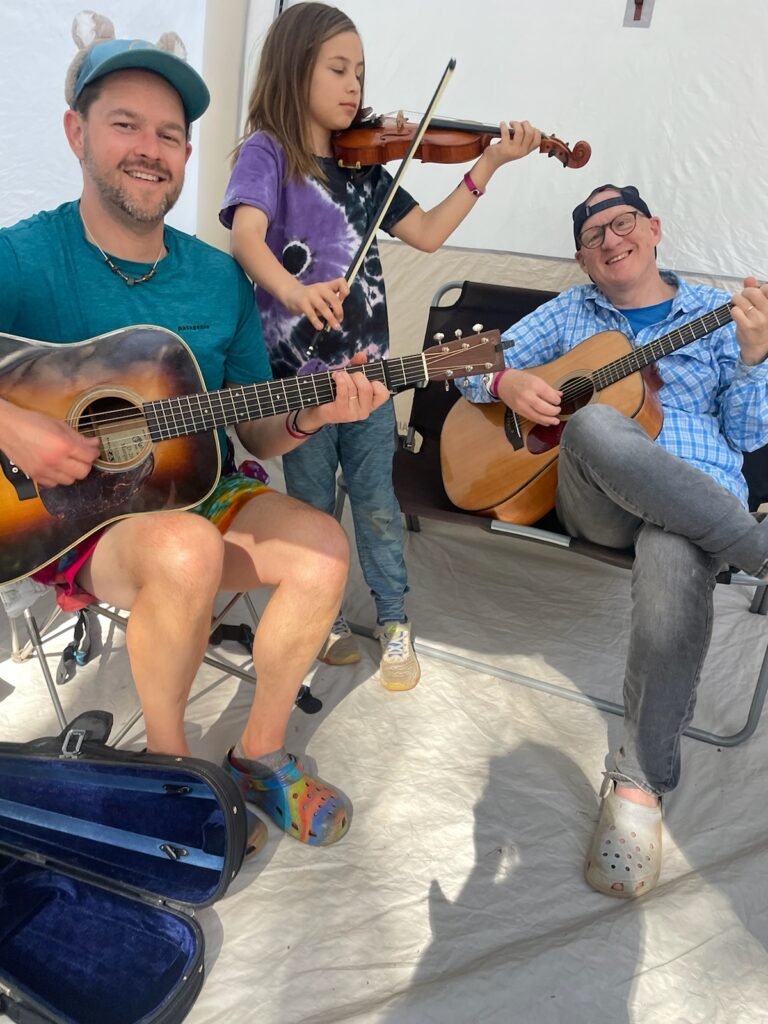
I am living testament to the value of this ethos. In the early 2000’s, at Kamp Koala at the Strawberry Music Festival, musicians such as Lisa Burns, Larry Chung, Dave Courchaine, Jeff Ward, Wendy Wendt, Rodger Phillips, Scott Micale (RIP), Megan Lynch, and others created a hole in songs so I could build up my chops. More importantly, they welcomed my two sons into those songs, and gave them room to take breaks. Now John is Critical Grass’s mandolin player, and David plays guitar to accompany his ten-year-old on fiddle. I have undying respect and appreciation for this tradition.
In these old-time jams, with no singing to sing of, [2] and no solos, there’s no need to make a hole in the song or the circle for newbies. This isn’t to say newbies aren’t welcomed. More accurately, they’re brought in, while the train is running, at full speed. Conveniently, though, the train is running in a musical circle, so if they miss it this time around, it will be back shortly.
The old-time players seemed just as helpful to the newbies as those bluegrass players were to me a quarter century ago. In the front left of the “Hawk is a Mule” video, you’ll see a fiddle player with close-cropped hair. That’s Luke Abbott, and he’d often pause his playing to hold up chord fingers to the newer rhythm players. The delicious irony of this is that Luke is the creator and maintainer of StrumMachine, an invaluable app that (wait for it…) teaches musicians chords to songs and provides accompaniment. If a man is called to be a teacher…
One jam, under a groove
George Clinton envisions one nation, under a groove. Sadly, we are far from that ideal. But I now understand the appeal of a raging old-time jam:
It’s the groove.
A fiddle player friend of mine says it’s trance, which seems on-point. You don’t have to remember the third verse of “Cabin in the Hills of Caroline,” or prep for your solo, or bemoan how you could have played it better. Whatever you’re doing, it’s the same thing over and over again, allowing your fingers to do all the work, and your brain to check out. I see how it put Elena to sleep – it’s the musical equivalent of counting sheep, but with a much better melody.
I now understand what it’s all about, and I’m a fan. I still love my bluegrass friends. And I adore my bluegrass band. But when dark falls on the festivals, I will be out looking for the old-time people. To chase a tune, and once they pull me on-board, sit in the middle of a musical whirlpool with no predefined end.
But next time… next time, I’ll have my glow sticks with me.
[1] Interestingly, this is most notable in California. In the Nashville bluegrass jams I’ve been in, song choice is made by whoever has the best next song to play. And the breaks are designed to fit the song, not vice versa.
[2] Virtuoso mandolin player and co-leader of epic band Watchhouse, Andrew Marlin, wrote a fiddle/mandolin tune called “Hawk is a Mule.” The entire lyric consists of singing “Well a hawk is a mule.” halfway through the B-part.
You were off from school this week, so Ana and I got to have a day out with you on Friday. Ana had it all planned that we were going to go to the Exploratorium, and maybe cable cars, and maybe Salesforce Park, and, well, who knows? That’s the cool things about our outings – they just sort of unfold with the day.
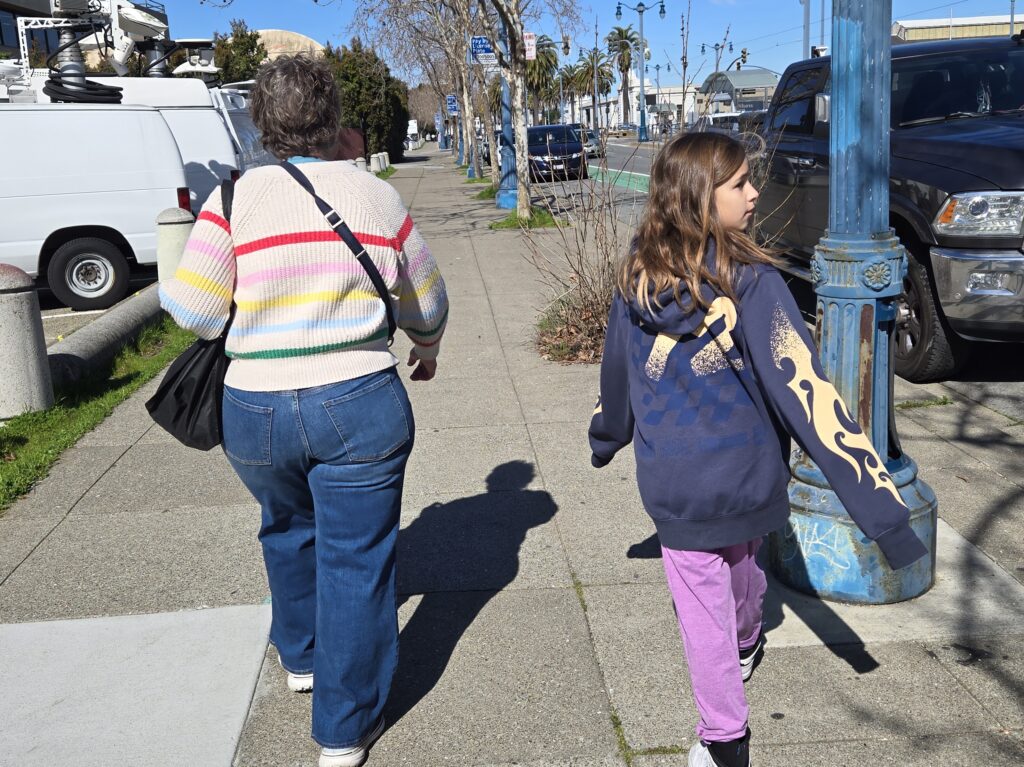
I was up in Rohnert Park, north of San Francisco, working at a casino event, so I drove down to meet you guys. You and Ana took the ferry over (you ate a Kit-Kat on the way), and I had already parked near the Exploratorium. I started walking toward the ferry terminal, and you all were walking from the ferry terminal toward the Exploratorium. But I saw you first, and hid behind a big column. Then I just started walking behind you. It looked like this:
Elena and Ana, loose in San Francisco
So I snuck up behind you two and just started walking right behind you. After a minute or so, I think you sensed me being there, and turned to look. You almost jumped!
“Aby!”
And I got a big hug, which was awesome. Now, we were supposedly heading for the Exploratorium, which would have been fine. But Ana said, “Elena said they might be hungry.” It was 10:30am.
Rules, and grandparent rules
All grandparents know that there are two different kinds of rules:
Rules
Grandparent rules
#1, the “Rules” list, applies to you, all the time, no matter what. For instance, “Wear your seatbelt,” “Say please and thank you,” – those are rules all the time, whether you’re with your parents, your grandparents, or any grown-up. But grandparents get to modify some of the rules. That’s the second list.
You had asked your mom that morning when lunch was, and she said, “You have to wait a couple of hours.” But a grandparent rule is that if you’re hungry, then it’s fine to eat. So Ana found us a tiny little sushi place that was a five-minute walk away.
We got inari (lots of inari) and avocado rolls, and Ana got a sushi roll of some sort. Didn’t matter that it was 10:45am – grandparent rules say you can have sushi for brunch.
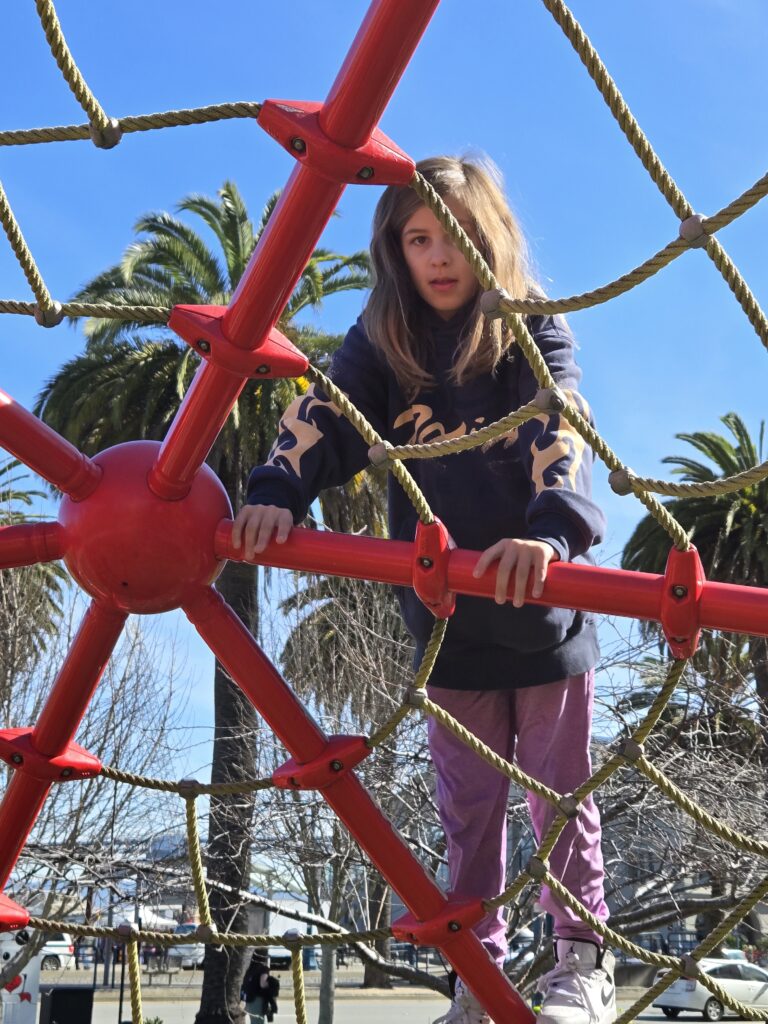
Then we went to the Exploratorium, but first we had to stop at the rope jungle gym.
Once a climbing kid, always a climbing kid
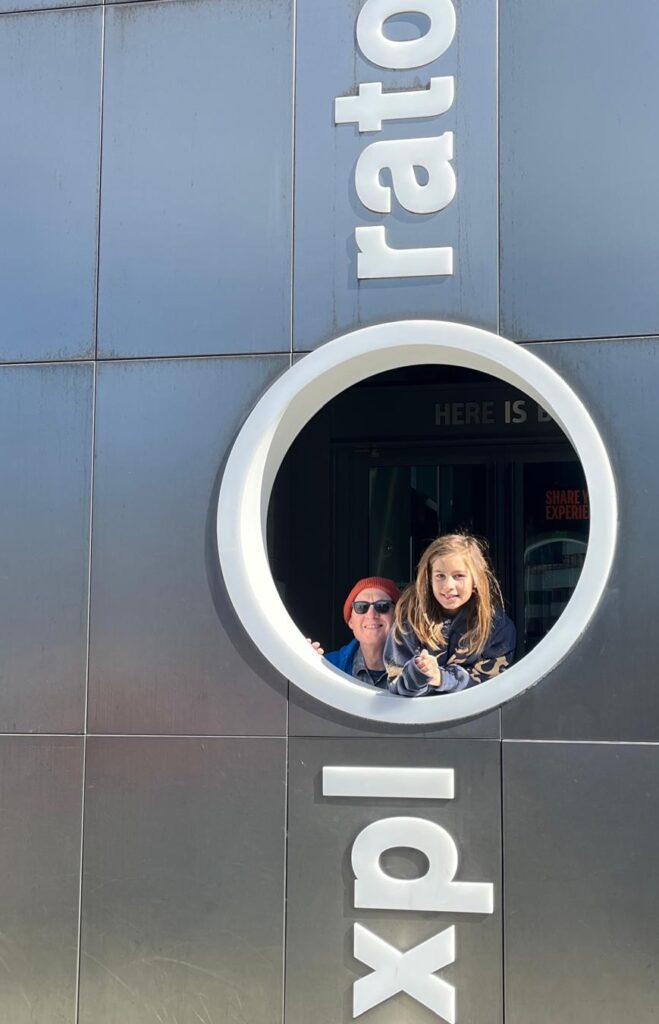
Then we finally made it to the Exploratorium. But that’s the whole point of days out with Ana and Aby – we just let the day unroll and see where it wants to go.
Once we got inside, there were infinite things to see, so we just started strolling through, enjoying everything. You’d wander along until an exhibit caught your eye, and then you’d stop and investigate it. Ana and I would just wander at your pace, your stops, having a blast the whole time.
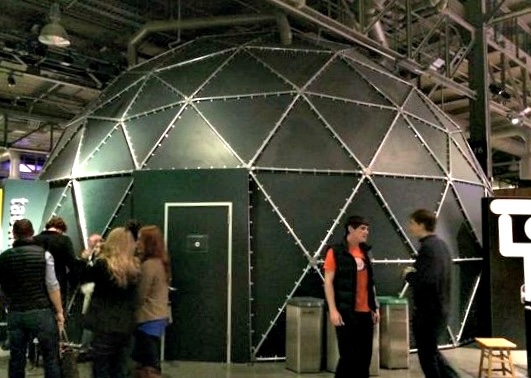
But pretty soon, it was time for you and me to go to the Tactile Dome. When you first heard about it, you were really excited to sign up for it, so we had a 12:15p appointment there. The Tactile Dome is a giant two-story dome in the middle of the Exploratorium, and it looks like this:
What it looks like on the outsideWhat it looks like on the inside
I can’t see a thing
The whole point of the Tactile Dome is that you’re crawling through a series of rooms, tunnels, hills, and slides. In. Absolute. Darkness.
Ana sent us on our way to it, and you were sort of bouncing around as we made our way toward that exhibit. E-blast, one of the best things about you is that you have your emotions right out in front where everybody can see them.
“Are you excited? Nervous?” “Excited. And nervous. And excited.”
Which sounded just right.
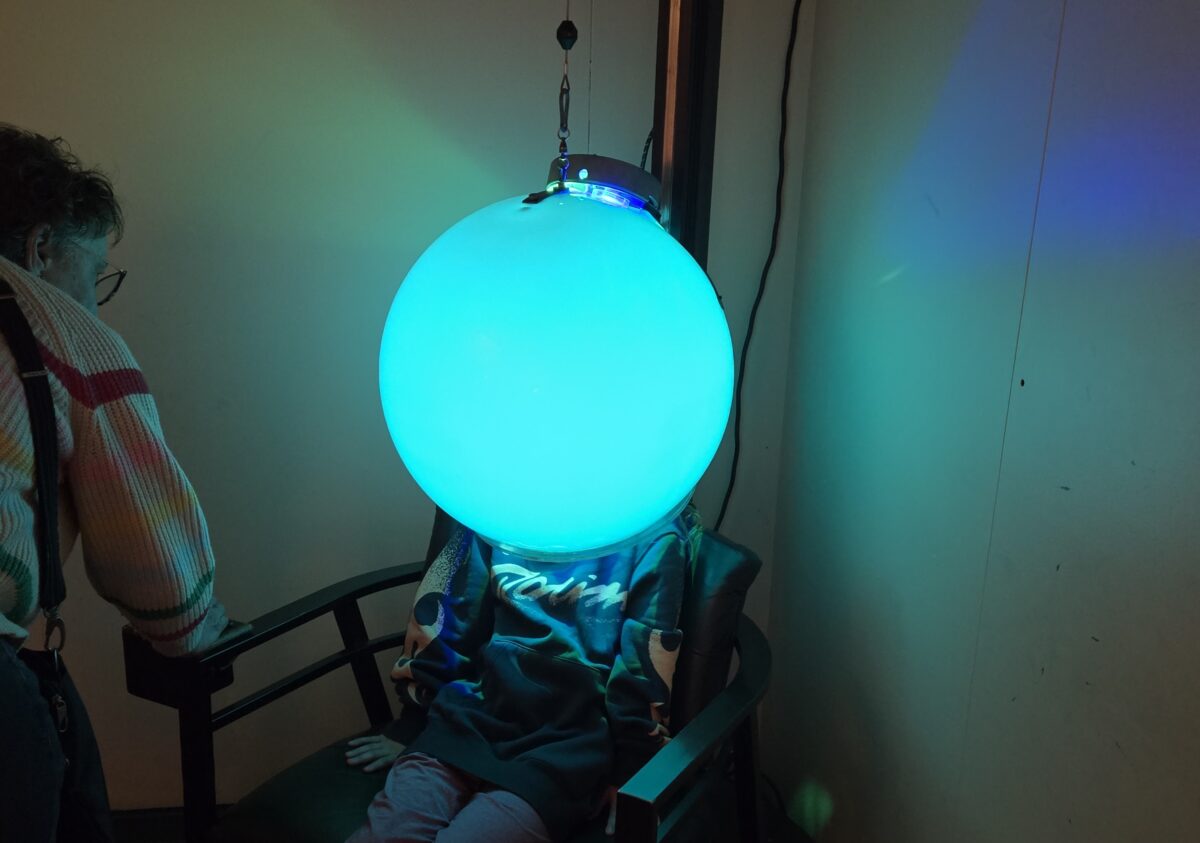
We got inside the exhibit, where our guide, Luis, lowered the lights and explained how everything was going to work. We took our shoes off, and put all our “stuff” in cubbies, because if you dropped something inside the Dome, well, it was going to be a while before it got found.
There was just one other woman for the tour that we were doing. Luis let her go in first. When she got half way (he can see people on infrared cameras) he sent us in. He pulled back a curtain, and in we went.
“Aby, where are you?” “Right here.” “Oh, there’s your arm. Okay.”
You wanted to immediately try to find our way to the next room, but I wanted to stand up and feel around. But pretty soon, you said, “I found a door!” Off we went.
At first, you stayed very close to me, and wanted to kind of hang on. But as you began to figure out the general idea, you became more adventurous. I would stop and reach up – I found a chandelier made out of forks and spoons.
At some point, Luis came on the speaker, and said, “You’re halfway through.” I could hear your excitement in the dark – “Aby, we’re doing this!”
Pretty soon, we were climbing up a hill, and we could begin to make out red light in a big round room. One sign said “Up,” and the other sign said “Out.” If you went up, you got up on a shelf, that circled the entire room. Half of the shelf of padded vinyl, the other half was fake grass. We chased each other around the shelf for a little while, then sat in the dim red light, proud of ourselves for making it through the “dark forest.”
To get out of the exhibit, there was one more slide we went down (in pitch darkness) – it landed in a giant pool of what felt like beans. So there we sat in the dark, buried to our waists in beans. The one other lady had left long ago, so it was just the two of us. I suggested we exchange gratitudes. You said,
“I’m grateful for crawling around in the dark. And sushi for breakfast.”
Those seemed like two good gratitudes, and I expressed something similar.
Then we went back into the little preparation room, and put on our shoes and jackets and stuff. Luis raised the light levels a little so our eyes wouldn’t be freaked out when we got out to the main area.
Ana was waiting for us, and we went to see more exhibits.
Frozen in time
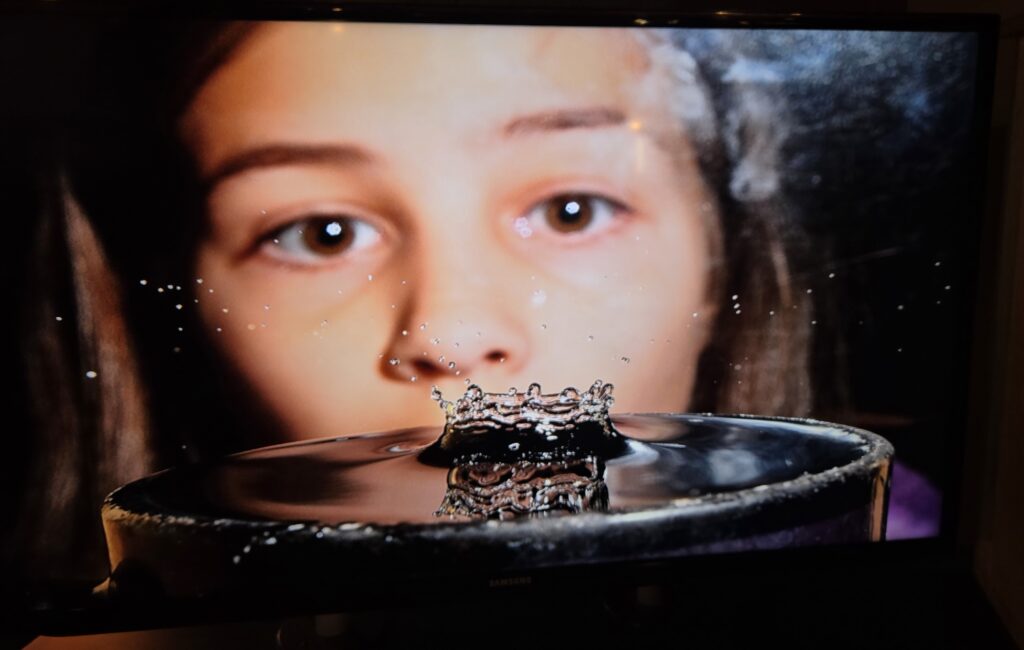
One of the coolest exhibits was showing the work of Harold Edgerton, who invented strobe photography. A “strobe” is a super-fast blink of light that can capture insanely fast things. Like a drop of milk hitting a glass of milk:
At the Exporatorium, you could be part of your own strobe photo. They dropped a drop of water into a pool of water, with your face watching the whole thing. Of course, our eyes can’t see the beautiful thing that happens, but the strobe caught it. Here’s you, not seeing the beautiful pattern from the water droplet:
I completely lost track of all the different exhibits we went to. I do know that occasionally Ana or I would say, “Are you about done, or do you wanna see more?”
“I want to see more exhibits.”
And so we did. But finally it was Hungry O’Clock, and we’d been on our feet a lot. So we went to the restaurant at the Exploratorium and had snacks, leftover avocado sushi, and chocolate milk. Which was all it took to revive you.
“I’d like to go on the Tactile Dome again.”
Life is short, and when you find a ride you wanna go on, you go back.
Ana was perfectly happy for the two of us to do it again, and Luis was happy to see us again. This time, there were two moms and their daughters. One of the moms was game to go through, but the other one was going to send her daughter, who is 12 (minimum age to go by yourself) on her own.
She went first, and Luis let her get halfway through before he sent you and me in. This time, you were ready to rock and roll from the jump.
“C’mon Aby – we go through this door, then up a ramp…”
We moved relatively quickly through the tour this time, and you knew exactly where you were at all times.
Flying solo
After we got out, you and the two girls were ready to go back in. By yourselves. The one mom had had enough of the darkness, and I had already gone through three times.
You and the two girls, both of whom are about your age, went in as a trio. Luis, the two moms, and I sat in the dim light of the ante-room, and listened as the three of you chattered and laughed your way through.
Was this the same E-blast who, earlier that same day, was excited, nervous, and excited about going into the darkness with a granddad in tow? Sure was. Now E-blast was a confident adventurer, making their way through the darkness without the least hesitation, calling their position out to the others (“I’m in the rope room!”).
For me, it was almost – almost – as much fun hearing you confidently making your way through the tunnels and ramps as being on the adventure with you.
Eventually, you all came shrieking down into the bean pit, and it was time to go.
You all: “Can we go again again?”
Luis: “Sorry, time’s up.”
You all: “Aw.”
We put ourselves back together and went outside. Ana was sitting on the same sofa, waiting for us to get back from yet another adventure.
A big crazy adventure
This time, it really was time to go. We made our way to the exit. You and Ana were going to walk back to where your ferry would take you to Alameda. My car was parked across the street, so I was going in the opposite direction.
You dove in and gave me a hug like I don’t think I’ve had from you since you were maybe 4-5 years old. E-blast, I’m going to tell you something: those hugs never get old. That full-body, face in the hoodie hug – man, my heart is good to go for a week after one of those. So thank you.
As I was walking back to my car, I got to thinking about the Tactile Dome, and going through tunnels and slides in the dark with you.
I rarely know where I’m going in life, and sometimes it feels like I’m stumbling along in the dark, going through secret doors, and crawling up ramps. But Elena, if I can hear your voice, feel your hand in mine once in a while, I won’t care in the least. Life with you around is a big old adventure, and tripping in the dark is just part of the fun.
P.S. When we got outside the Exploratorium, I put my hand in my hoodie pocket, and felt something. Pulled it out – it was a bean from the bean pit! Faster than a strobe-light could catch it, your hand shot out and snatched it from me. It was the perfect souvenir. Only you lost it at some point during that, or the next day.
People have been singing you to sleep since you were born. When I have the extraordinary opportunity to sing you to sleep, I sing some songs that the other lucky grown-ups don’t. Like, “If I had a Boat” by Lyle Lovett. You like that one a lot, and sing along.
You see, there’s this one couplet, where he’s talking about a theoretical daughter he might have…
Maybe one day she’ll take a fancy to picking, Cause when that bug bites you, you live with the sting.
“Picking,” as you’ll know by now, is what bluegrass musicians call just sitting around and playing music. “You wanna pick?” “Let’s pick one.”
And darned if you haven’t become a picker. The instrument that you picked to pick on doesn’t use a pick, though.
Fiddle
The first musical instrument you started taking lessons on was drums. You actually did pretty well with that, and in fact, I wrote a blog about you playing drums.
But after a few months, you said you wanted to give up drums. What you really wanted to play, you said, was fiddle. We were all a bit skeptical, but you continued on the fiddle theme for quite a while. Then the universe smiled on us all. Because I was playing in a band called Critical Grass, and the fiddle player in that band is an extraordinary woman named Leah Wollenberg. Well, Leah teaches fiddle at Manning Music in Berkeley, and they thought that Leah would be the perfect teacher for you.
They were right.
You and Leah immediately bonded over Harry Potter (I think she might be a Hufflepuff) and became really good friends. She’s also doing an amazing job of teaching you fiddle. And it seems like you’ve truly taken a fancy to picking – you are eager to pull out your fiddle when there’s an opportunity to play.
In fact, when we were up at Strawberry this year, you brought your fiddle, because pickers bring their instruments to Strawberry. So your dad and I got to sit and pick a few with you.
You’ve already outgrown one rental fiddle and are on your second (third?) one.
You and Leah keep learning more new tunes. You started with Boil Them Cabbage Down, because that’s what all of Manning’s students start with. Then Old Joe Clark. Cluck Old Hen, and we all got to sing along:
My old hen’s, a real good hen – she lays eggs for the railroad men. Sometimes one, sometimes two, sometimes enough for the whole damn crew. Cluck old hen, cluck and squaw – ain’t laid an egg since late last fall. Cluck old hen, cluck and sing – ain’t laid an egg since late last spring.
Leah taught you Elk River Blues, which I’d never heard, but is a beautiful tune. And now you’re starting on Soldier’s Joy.
Playing with the band
A few weeks ago, our band, Critical Grass, was going to be playing a gig at Gather in Berkeley. You’ve been to Gather plenty of times to see me and Uncle John play music, but you mostly ate french fries and crawled around the garden area on the patio.
But a couple of weeks before this gig, Leah asked you, “Do you want to come up and play a tune with us at Gather?”
Somewhat to our surprise, you said, “Sure.”
So on Saturday, September 7, 2024, you, your mom, Ana, and Great-Gran were all sitting at a table at Gather. You were probably eating french fries. Leah said into the microphone, “Okay, Elena, it’s your turn after this song, so get ready.”
Ana said, “Let’s get your fiddle out of its case.”
Nope. You took your fiddle case over to where the band had all their fiddle cases. You set it down right next to Leah’s fiddle case, and then opened it up. Because hey, when you’re with the band, you’re with the band, right?
After that – well, let’s roll the video…
Elena Haupert plays Old Joe Clark with Critical Grass at Gather in Berkeley. 9/7/24
I couldn’t have been more proud. And man, Leah, she was over the moon at how well you did.
After we finished Old Joe Clark, you went over to where your mom and Ana were sitting (they’d switched seats to be really close to the band when you played). You plopped down in your mom’s lap.
“How was it?”
“I’m still shaking.”
I get it – stuff like that can make a person nervous. But you did marvelously. In fact, you did better than you may have realized. At one point, Leah was playing the melody an octave below you. Maybe because she wasn’t exactly doubling you, you got a little off. This is what Leah told me:
“Gotta say the moment I felt proudest at Gather was when Elena got off while I was playing the melody an octave below. They stayed totally calm and got right back on within a few seconds. That’s some Real Musician stuff right there.“
Real Musician stuff. Nice.
Over a century of picking
Years ago, people didn’t have the Internet. Or TV. Maybe they had a radio, but in poorer parts of the country, they didn’t even have that. What they did have was a few musical instruments. And on a Friday or Saturday night, they’d sit on the porch, or in the back yard, depending on the weather. They’d play music, and people would dance.
And this past week, you got to be part of your first backyard picking. I mean, you’ve been around backyard (and living room and campsite) picking since before you can remember. Like, check this out. When you were just turned five:
I wanna call the next tune. How about Let it go?
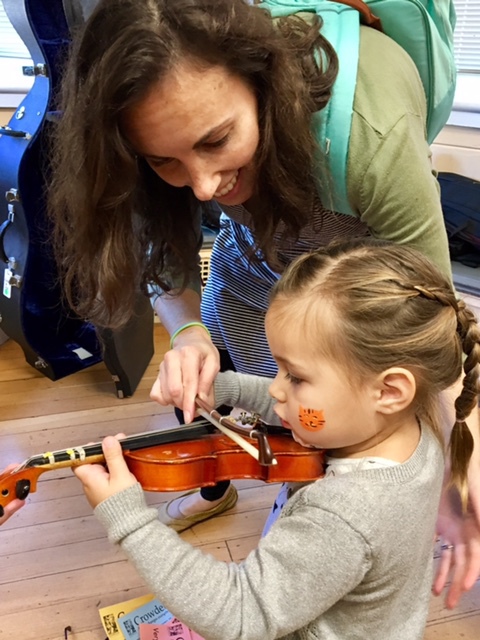
In fact, you and a fiddle had gotten introduced to each other many years ago, at an instrument “petting zoo”:
Your mom said you started crying when you heard the bow pulled over the string. Which, any of us who have been around beginning fiddle players understand.
Interestingly, once you started studying with Leah, that didn’t happen. Somehow, almost from the first lesson, nice sounds came out of your fiddle.
But this was the first time you were part of the circle.
Picking in your back yard
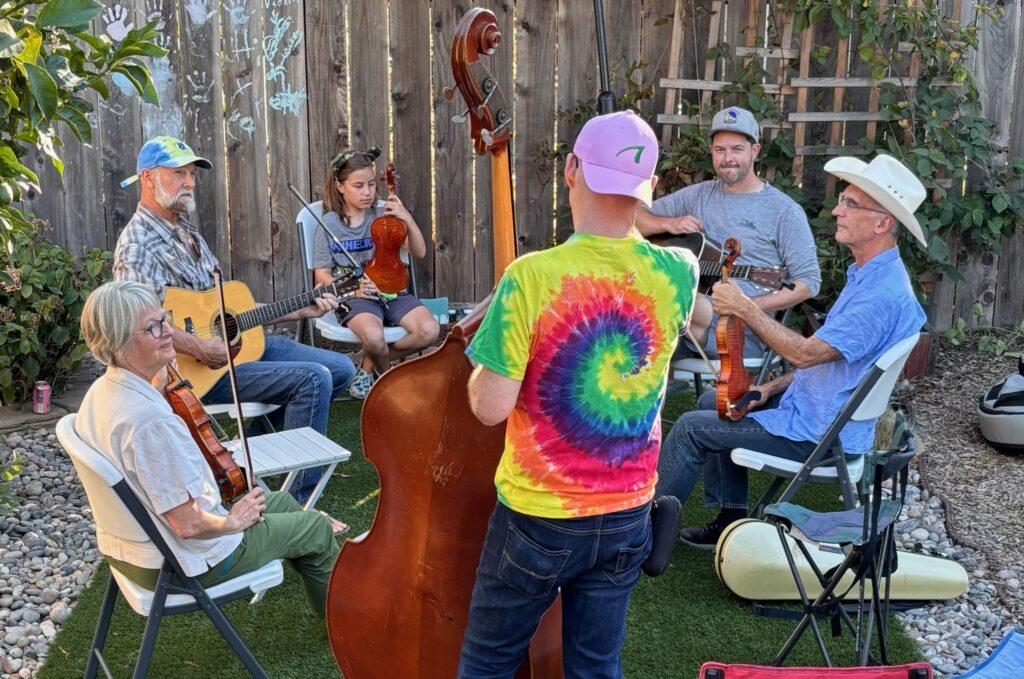
It was a slightly delayed birthday party for me at your house, the day after you played at Gather. Your dad had set up chairs in a big circle in your backyard, and invited a bunch of our friends over. Everybody ate hot dogs and hamburgers, then it was time to pick.
You went to your parents’ room, and got your fiddle. You carried it to a chair in the circle, sat down, opened up your case, and waited. Good job you’re patient, because pickers can procrastinate. In fact, there’s a phrase that we use sometimes:
“Are we going to talk, or are we going to pick?”
Starting from the tie-dye guy: Aby, Mary Schriner, Jeff Ward, E-blast, Dad, John McFarlane. Uncle John and his mandolin sat down shortly after.
And here I want to give a big shout-out to the pickers. Because once everybody sat down, we all looked at you, and somebody said, “What do you know?”
“Old Joe Clark.”
And so we played Old Joe Clark. And man, E-blast, you nailed it, playing along with everybody, just like you’d done the day before at Gather.
When we finished that, we played Boil Them Cabbage. And Cluck Old Hen. With the words.
There were 8-10 people up on your brand new deck, eating dessert and enjoying the music. After every tune, they’d cheer and applaud. Your great-grandmother, Liz, got to hear you in the middle of the picking circle!
Mary Schriner, a lovely woman and fiddle player who we’ve met only recently, said, “If you study at Manning, you might know Elk River Blues.”
“That’s a great tune,” I said, “But I don’t remember how it starts.”
“Me neither,” said Mary.
John the fiddle player said, “I’ve heard it before but…”
Then you said, “Oh wait. I think I might be able to start it.”
Sure enough, you played the first few notes, and everybody said, “Oh yeah!”
Next thing you know, we were playing Elk River Blues. Jeff, Uncle John, your dad, and I worked out the chords, and we played it through 3-4 times. It was so lovely, and everybody got to enjoy it all because you were able to remember the opening phrase and play it. Later, Ana said, “Can’t you just hear the river in that tune?”
“Yes, I can,” said you.
Just a few of us picking…
Elena, families and friends picking together is a tradition that goes back over 150 years. I’ve been picking since I was a teenager 50 years ago. In front rooms, back yards, camp sites, garages, and little country stores in the middle of nowhere in the Blue Ridge mountains.
I’ve picked with octogenarians and six-year olds.
This music, and any music like it, is magic. You don’t need a big old band, or amplifiers. You don’t need electricity, sheet music, or a conductor. You just need a handful of people and their instruments.
Sometimes there’s an audience (like at Gather, or the listeners on your deck this past Sunday). Maybe you’re picking in a camp site, and passersby stop to listen, because it makes them happy. But sometimes, it’s just a few of us picking.
There’s a huge fabric of people making music together. My uncle Harry (Hunter’s brother) used to pick in the side yard at the cabin with Wayne Henderson, the fellow who built Rose the guitar. Then Harry taught me my first bluegrass song on the guitar (“Love, please come home“) and bought me my first bluegrass album (Bill Monroe’s Uncle Pen). I taught your dad and Uncle John some tunes. Now you’re learning from your dad, and Uncle John, and me. And, of course, Leah. Mostly Leah.
We’re all threads in this fabric of music weavers, and now you’re a thread too. I am so blessed that our musical threads are intertwined. And I hope that somewhere down the road, you’ll be teaching Elk River Blues to your kid, or the nine-year-old next door who’s entranced by your fiddle.
‘Cause when that bug bites you, you live with the sting.
“Autonomy” is a big word, and a big idea. It means that you get to decide what you’re going to do. When you’re a baby, you have zero autonomy because you’re helpless. You need people to feed, clothe, and generally care for you.
As you get older, you become more and more “autonomous” – you can make your own decisions. Like at a certain age, you started having opinions about which clothes you wanted (and didn’t want) to wear. Because your parents are cool, they pretty much let you choose your clothes. And suddenly we all got a better understanding of who you were, because of clothes you chose.
Like most kids, you’ve gotten more autonomy with each passing month and year, but man, Strawberry this year – it was a big jump.
You were jumping out of your skin with anticipation for Strawberry this year. Last year was your first year there, and you thought it was the bomb. This year, your BFF Ayla was going to be there and that was definitely what you were most excited about.
Setting up camp
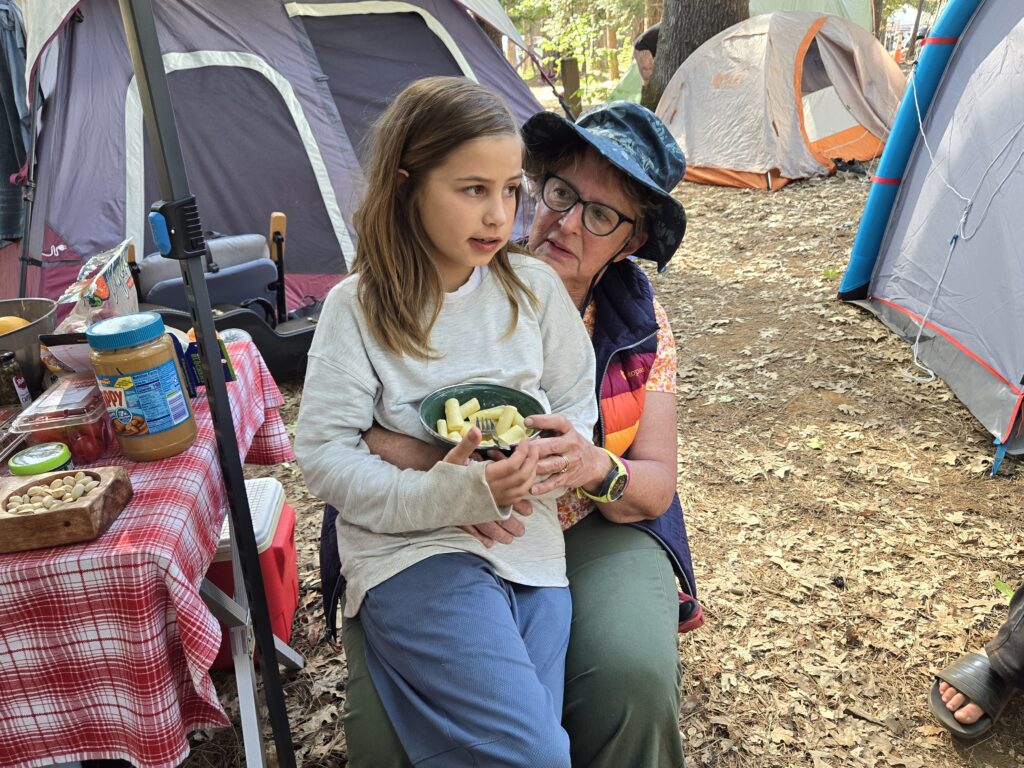
Your dad and I arrived Wednesday and got camp all set up. He did the really important work of finding “real estate” – a place for us to set up camp. He found an amazing spot near the parking lot, and just a few feet from the amphitheater where all the kid activities are.
Thursday, you and Ana drove up together, and got stuck in awful traffic. Ana said you were super chill about the whole thing, but man, when you got out the car, you came running…
“Aby! I’m at Strawberry!”
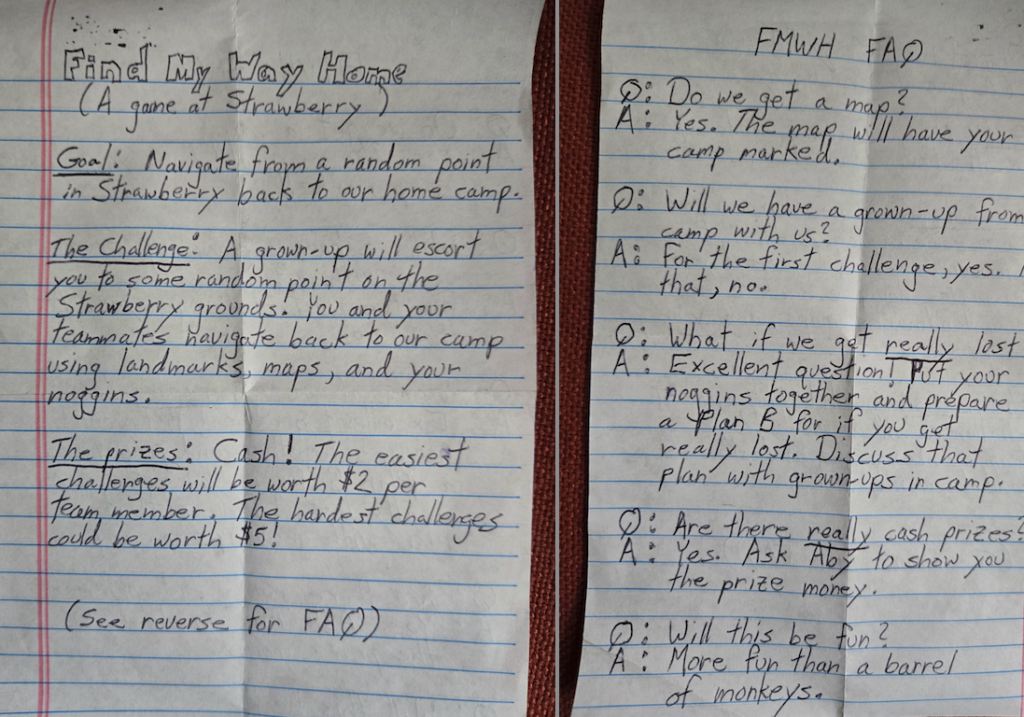
Yes, you were. While we sat around eating dinner, I told you about the “Find My Way Home” game I’d created. The fun thing is that now that you can read, I could just hand you the piece of paper, and watch you take it in…
“Aby, what’s a FAQ?”
You thought that was pretty cool, particularly as it dawned on you that you were going to be navigating around Strawberry on your own, with Ayla.
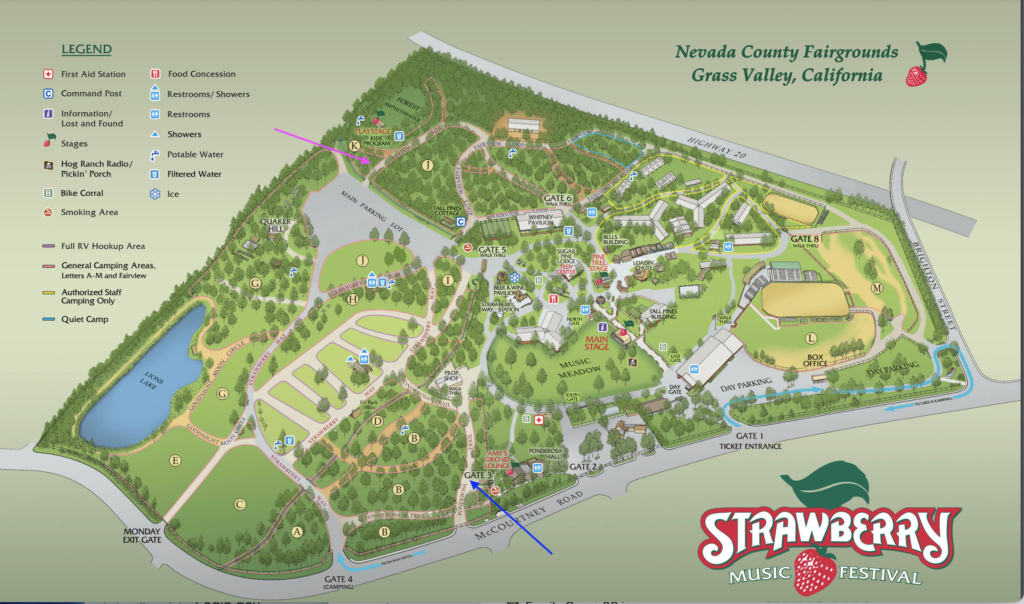
See, Strawberry is held at the Nevada Fairgrounds in Grass Valley, California. It’s a pretty big place, and I wanted you and Ayla to feel that you could find your way to and from the music meadow, or other activities, without needing a grown-up along.
It’s also a way to be sure that if you get lost, you can get un-lost. Strawberry is the perfect place to do this. It’s an enclosed, gate-protected place, there are staff people all over, and if you got lost, there was a sea of tie-dye-wearing grown-ups, any one of whom would ensure you got back home.
Challenge #1
Friday afternoon, after Ayla, her mom, and your mom arrived, we did the first challenge. You, Ayla, and I walked to Gate #5, which is the main entrance way from the parking lot into the area where the music is. It was a straight shot along the back of the parking lot from Gate #5 back to our camp.
Ayla said, “It will be easy to find our way home from here.”
“Yeah,” you said, “No problem.”
“You’re not supposed to say that!”
You both got it immediately.
“Oh, we think we can find our way home from here.”
So I turned you two loose, and off you went. I hung back to be sure I wasn’t in the way, and even took a detour so I got back to camp a little bit later.
“We got back without getting lost, Aby. Do we get $2 each?”
You sure did.
But it wasn’t the money that was making you and Ayla smile. Those were the smiles of confidence and autonomy. For one of the first times in your life, you and Ayla were going somewhere without a grown-up accompanying you. With your own smarts, sense of direction, and good sense to take care of you.
You had every reason to smile.
Camping out
You and Ayla set up Ayla’s tent in a little island between our family camp and the amphitheater. You decorated it, including a map of Strawberry hanging from the ceiling. You went to the arts and crafts area, and made a sign to hang at your camp:
Y’all never slept in the tent, but it was your place. A place you could go to get away from the grown-ups if you wanted to. More autonomy.
Challenge #2
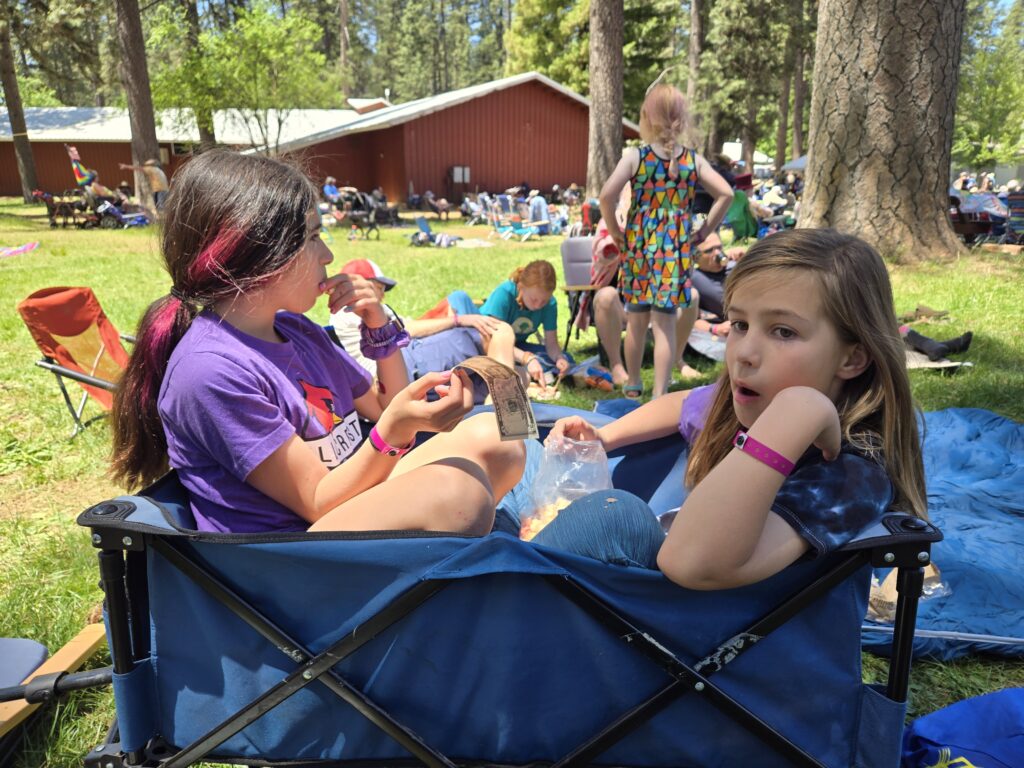
We were all down at the music meadow. You guys were sitting in the wagon together, and I got to thinking that this was probably the last season that you’d both fit in it together.
I asked you both if you wanted to do another “Find My Way Home” challenge.
“Yes!”
“Okay. This will be a five dollar challenge. Make your way back to camp, and then come back here. Bring something back from camp to prove that you got there. Oh, and you have a 20-minute time limit.”
I thought it would be a good idea to have a time limit, mostly to encourage y’all not to wander around and get distracted.
Ten minutes later, I get a call from your dad.
“Um, I need to give Elena eye drops. But they say that the timer is running and they can’t stay to get eyedrops. Could we pause the timer?”
I laughed so hard. “Sure, we can pause the timer.”
I went somewhere, and when I came back, you and Ayla were in the cart again.
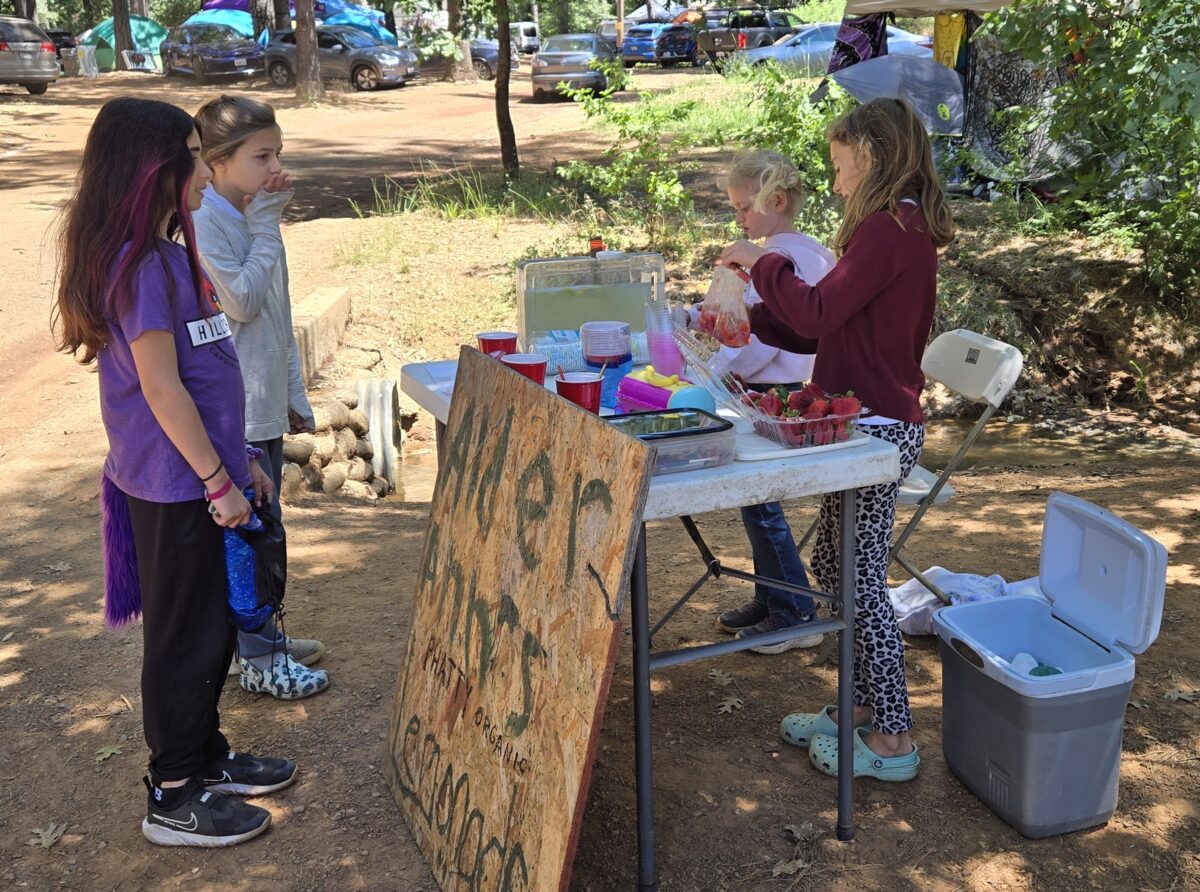
“Aby, you owe us $5!”
Since I’d gotten a call from your dad, I was pretty sure y’all had made it back to camp. I paid up immediately, and you immediately found uses for those $5 bills…
Note the tails
Raptor attention
Saturday morning, there was a raptor demonstration, including Roja the red-tailed hawk, at a little stage near the music meadow. You, Ayla, Rasta, Josie, and Ace all wanted to go to it.
Josie is 12, Rasta is 6, and everybody else is in between. Josie is an extremely responsible girl. I don’t remember how it all happened but the five of you set off to see Roja.
After a while, I looked around camp. There sat eight adults, having adult conversations.
“Wait. Do you realize what’s happening?”
“No kids,” giggled Josie’s mom.
Now Rasta, he’s six, and he can be a handful sometimes. There was some worry that he might be a couple of handfuls for you all. So I volunteered to wander down there and make sure everything was cool.
I quietly made my way up to the area where they were having the raptor show, saw what I needed to see, then slipped around to take a picture.
Raptors are the coolest. Except for Rasta, Ace, Ayla, Elena, and Josie
After the show was over, and you all had gotten up to get a closer look at Roja, I said you should probably head on home.
“Okay.”
And off you went. I hung back – I didn’t want you to feel like you were being followed.
But I stayed close enough to make sure that particularly Rasta didn’t go left when you went right. I was being silly…
You all ended up on the dirt path that follows the creek – a straight shot back to our camp. Rasta was hanging back, because he had six-year-old reasons you didn’t. Then I heard a girl’s voice from further ahead, “C’mon Rasta!”
And he did.
The biggest challenge
On Saturday afternoon, y’all told me you wanted one more big challenge.
“A big challenge?”
“Yeah.”
First, we walked down to the command post, where they had a big stack of camp maps. I wanted to be sure you had a map with you, because both of you are perfectly capable of using a map.
I explained the “Find My Way Home” challenge to the staffer there, and then we had a conversation.
“What if you get lost, I mean really lost?”
“We’ll find a worker person.”
“Okay, good first idea. And what will you ask them?”
Ayla: “How to get to the music meadow.” Elena: “How to get to Gate #5.”
Your noggins had worked out that you couldn’t ask where your family’s camp was, but if you got to either the music meadow or Gate #5, you’d know the way home from there.
Excellent thinking, E-blast.
I walked you to the farthest reach of the campground I could find. So far that I made it a $7 challenge. And then I told you that you had to start off in a direction opposite from the way we had come.
“No time limit, okay Aby?”
“No time limit. Go see the campground.”
The pink arrow is our camp. The blue arrow is where I dropped you and Ayla
When I got back to camp, you found me pretty quickly.
“We didn’t get lost or anything.”
Of course, the next step will be to get lost on purpose – go somewhere that you have no idea where you are. My mom, Peggy, had a t-shirt that said,
“Not all who wander are lost.”
I expect you have some great wandering ahead of you, and if you get lost, well, you know how to find your way home.
Home
Autonomy means a lot of things. It means you can wander off if you want to. But we all have to recharge our batteries. And there’s no better place to recharge your batteries than your home base.
So get out there, and put that autonomy to use. See, learn, explore, investigate, and even occasionally get lost. But just be very sure of this: your parents, Ana, me, Uncle John, Grandmother – all the people who love you – will always be there to hear the stories, put bandages on the wounds, and help get the batteries recharged for the next challenge.
So there I was at the Lansing, North Carolina farmer’s market, buying tomatoes from the nice Rose Mountain Farm lady.
Before the farmer’s market people set up their pop-ups
“Where are y’all located?”
“We’re up Big Horse Creek Road.”
“I’m headed up there this afternoon to go fishing.”
“That’s the main reason that anybody goes up there. Do you go for the meditation, or to catch fish?”
Well, let me think about that for a moment. It was 27 years ago that I first tried fly-fishing, thanks to my dear departed cousin Dean C. Jones. Once you’ve had a trout take a dry fly off the top the water, man, you’re way more hooked than the fish is.
But I’m not a studied fly fisherman. I don’t read the books, watch the training videos, take the classes, any of it. Because the truth is that it really is a meditation for me. A few days earlier, I was chatting with the fellow at the Old Orchard Creek General Store and Café, and told him that I was headed out to go fishing.
“I hope you catch some.”
“If I’m standing in a trout stream on a day like this, and I’m not blissfully happy, then that’s on me.”
“Well, that’s right.”
I find myself settled just looking at this picture. Imagine actually being there.
So I was tempted to tell the lady that it’s all about the meditation. But then I had an interesting thought, and relayed it to her:
“The more I meditate, the more fish I seem to catch.”
In the last year or two, I’ve started to have some real success catching fish. On this current trip, I’ve caught a handful of trout in Little Horse Creek, right here in front of my AirBnB.
I don’t stop to take pictures, but I promised my AirBnB hosts one pic. He went right back in.
This is significant because N.C. Wildlife doesn’t stock Little Horse Creek. They do stock Big Horse Creek, of which Little Horse Creek is a tributary. Some fish make it up there, but fewer than in the stocked streams. And maybe they get a tad smarter after being up there a while. So I’m particularly proud of myself for catching fish in a stream they don’t stock.
Here’s the thing: when I go out for a few hours of fly fishing, I’d like to catch one trout. The difference between getting skunked and catching one beautiful fish is enormous. After that, my cup overfloweth. But on this trip, and the last couple, I seem to catch 6-8 fish every day. That’s after years of thinking that if I caught two fish, it was an extra special day.
October 14th, 2023
I headed up to the northern end of Big Horse Creek, to the catch-and-release section. From there to the Virginia state line, you can’t keep any fish. I never keep any anyway, but it’s particularly beautiful and fishy water.
I also have a theory that the fish are a bit smarter. A lot of people in this county fish for dinner, so the stocked fish go from stream to pan. But in this stretch, they get put back. Where maybe they learn their lesson and don’t bite at every single buggy-looking thing that floats over.
I dunno if that’s true or not, but I sure had a tougher time getting strikes than when I was down on the lower part of the creek. Still, I managed to land three rainbows and one beautiful brown.
Around 5:30pm, it was getting dark-ish, and there was a light rain falling. I had determined I was going to have to scale a fairly steep hill up to Big Horse Creek Road to return to my car (it’s just a whole lot easier than clambering back downstream to my entry point).
I was pretty proud of myself for catching four fish in the “tough” section of the stream. And darn proud for climbing out of that canyon back up to the road without too much exertion. All that walking and jogging pays off.
Then a thing happened. I stood up at the top of the hill, and looked down the road, back to the car. Saw this:
I wanted to find the Rose Mountain Farm lady, and tell her I’d been mistaken when we chatted that afternoon. The correct answer is, “Yes ma’am – it’s all about the meditation.”
P.S. On most browsers, you can right-click on any image and open the image in a new tab. No picture will properly convey the beauty of the scene that awaited me when I reached the top of the hill. But you’ll do your heart good by filling your screen with that for a minute and just taking it in.
My dad’s parents, Hunter (senior) and Mattie, grew up in a tiny little community called “Helton,” in northwest North Carolina, just a few minutes from the Virginia state line. They ended up moving to Charlotte, and that’s where my dad grew up. But in 1951, they bought some land and built a summer home (“the cabin”) in the community where they’d grown up.
They would spend as much time up there as they could, during the summers. My parents visited them there, even before I was born. So I was going to “the cabin” in a stroller.
As I got older, Helton and the cabin was my favorite place in the world. At first, it was just the creek to play in, the sound of the water rushing over the dam, and the seeming endless forest that surrounded us.
I got a bit older, and became obsessed with fishing in Helton Creek. At first it was just chubs and other “rough” fish. But after I caught my first trout, well, I was hooked.
The years passed, and I went to Helton whenever I could. I’ve got 6-7 generations of ancestors buried in the family cemetery behind the white house across the creek from the cabin, going back to the early 1800’s. I call them my “friendly ghosts,” and they make me feel welcome and happy whenever I’m back there.
So when you were born, I always had a dream of taking you to the cabin, and introducing you to Helton Creek. I also wanted my friendly ghosts to get a look at you, and see what an extraordinary grandchild I had gotten in the inimitable E-blast.
Some years ago, Ana and I ended up owning half of the cabin, but because we lived in California, it was really hard for us to look after it. Fortunately, in 2020, we were able to sell it to my cousin, Greg Pool, who lives in the Greensboro, NC area. Greg and his family moved into the cabin during Covid, Greg taught from there, and his kids (Liam, Avery, and Lily) went to Zoom school there.
Once I’d met the Pool family, I wanted you to meet those cousins too – they’re pretty cool people.
Elena goes to the mountains
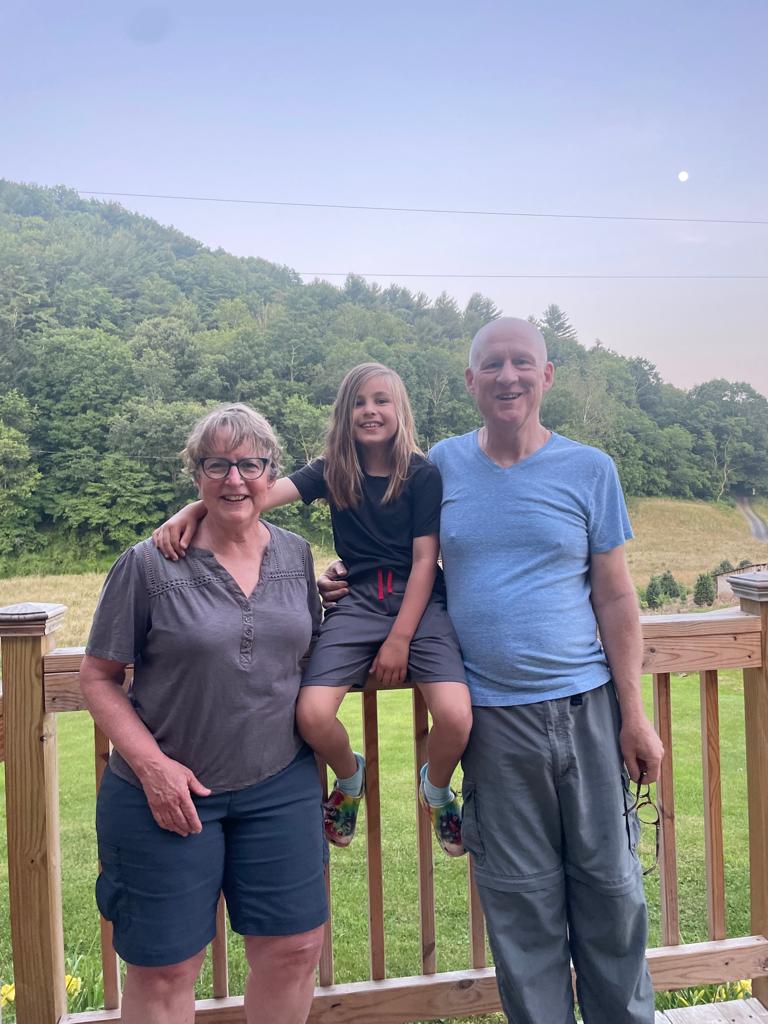
This year, your parents were kind enough to let us arrange a visit to the mountains for you and your dad. Ana joined us too, so we had a group of four of us, staying at a house in a place called “Fee’s Branch Road,” about five minutes from the cabin.
I flew in a couple of days before everybody else, got the AirBnB opened up, and groceries in the refrigerator. Then I drove down to the Charlotte airport and picked you two up. It was time to head up to the mountains!
It was about a 2.5 hour drive up to the AirBnB from the airport. You played on your tablet most of the trip, but as we got to the mountains, you rolled down your window. “There’s so much to smell!” Yes, a lot to smell up there.
Fishing
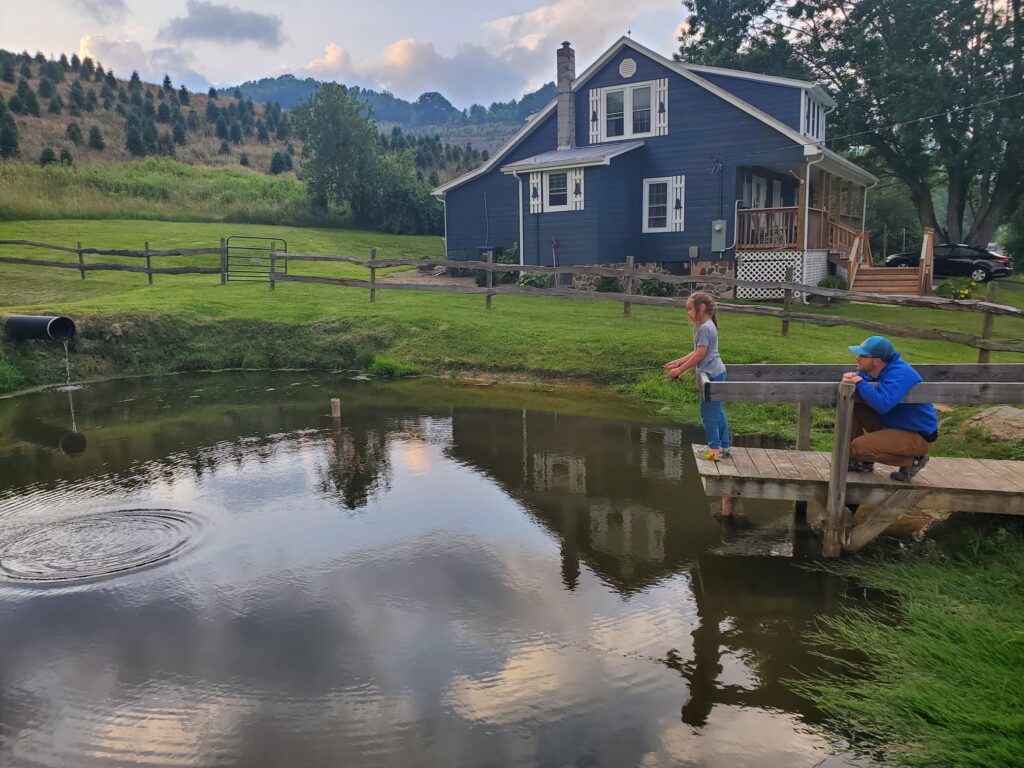
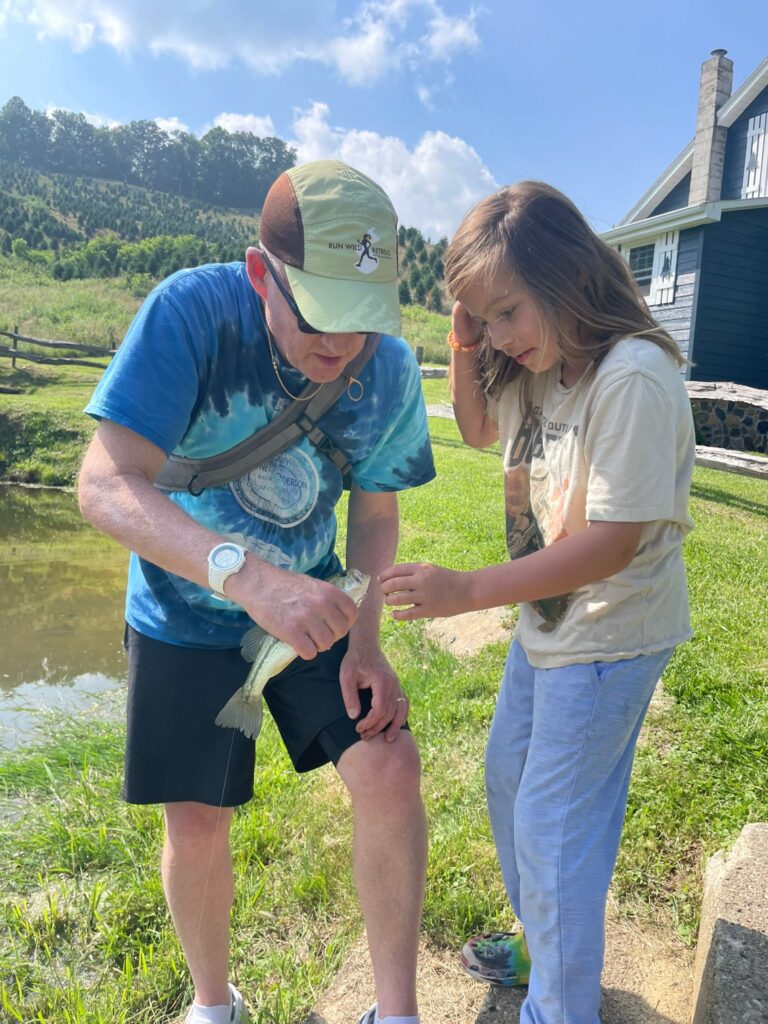
That evening, we outside and fished in the pond right next to the house. It was full of very stupid largemouth bass.
You didn’t catch any fish that evening, because we didn’t have any worms, but you got a couple of strikes, which was super cool.
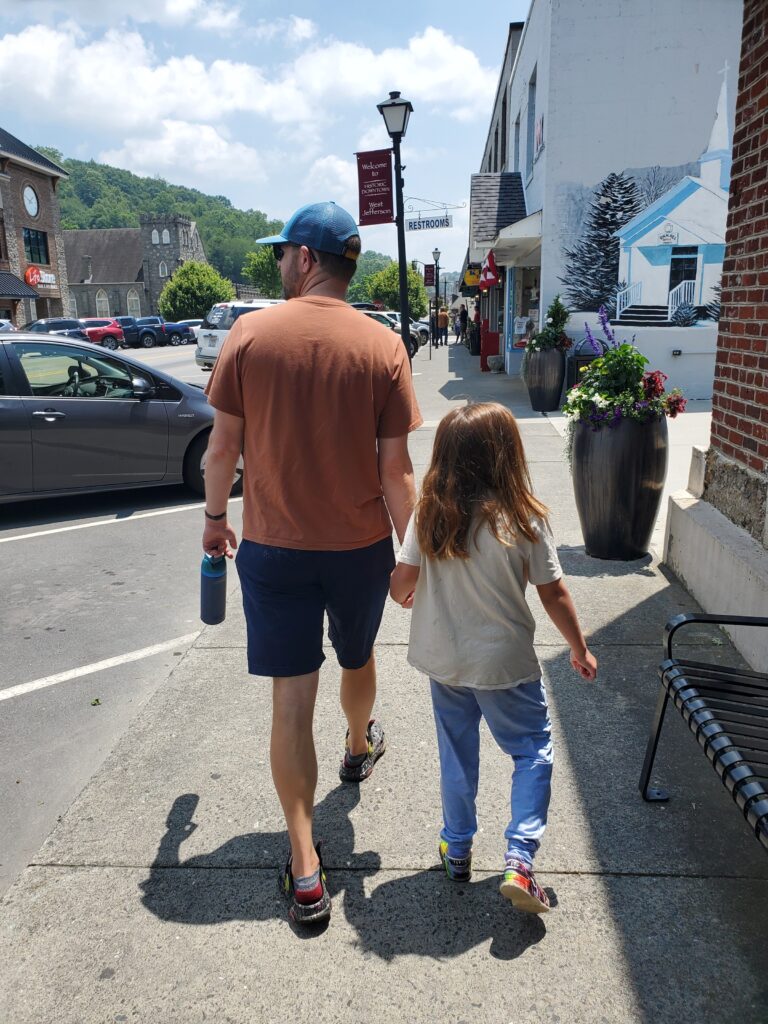
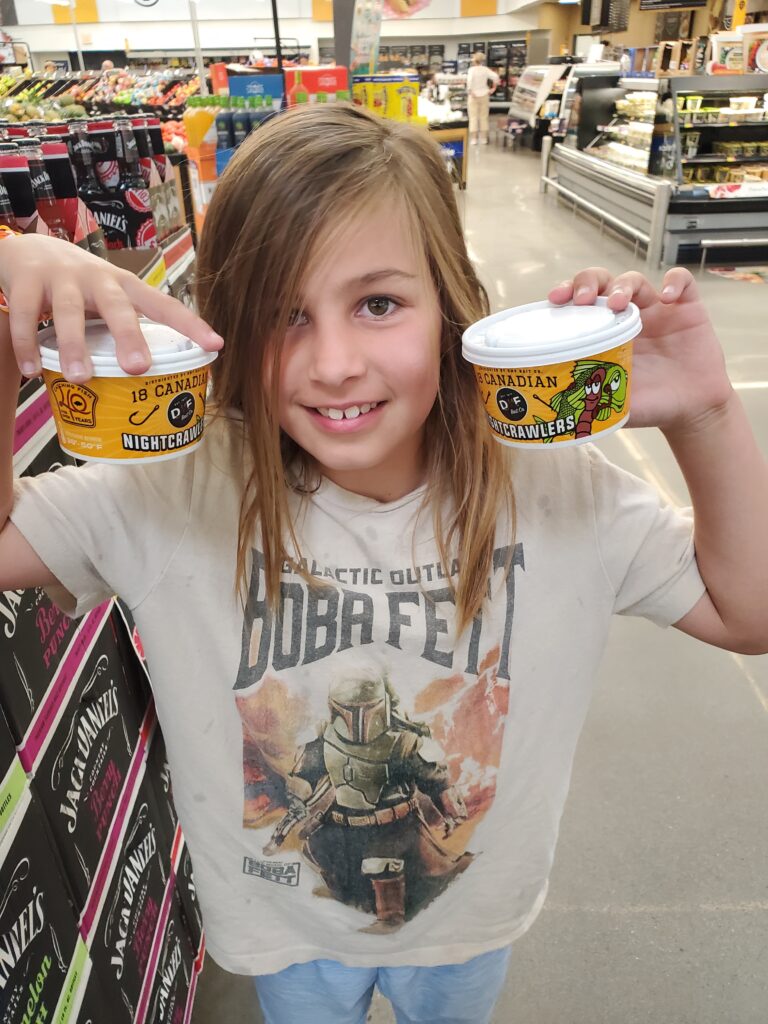
The next day, Ana was going to be coming in from Charlotte in her own rental car, so you, your dad, and I had the morning and early afternoon to ourselves. We drove down into West Jefferson, the nearest real town. We needed a few grocery things, water shoes, and worms!
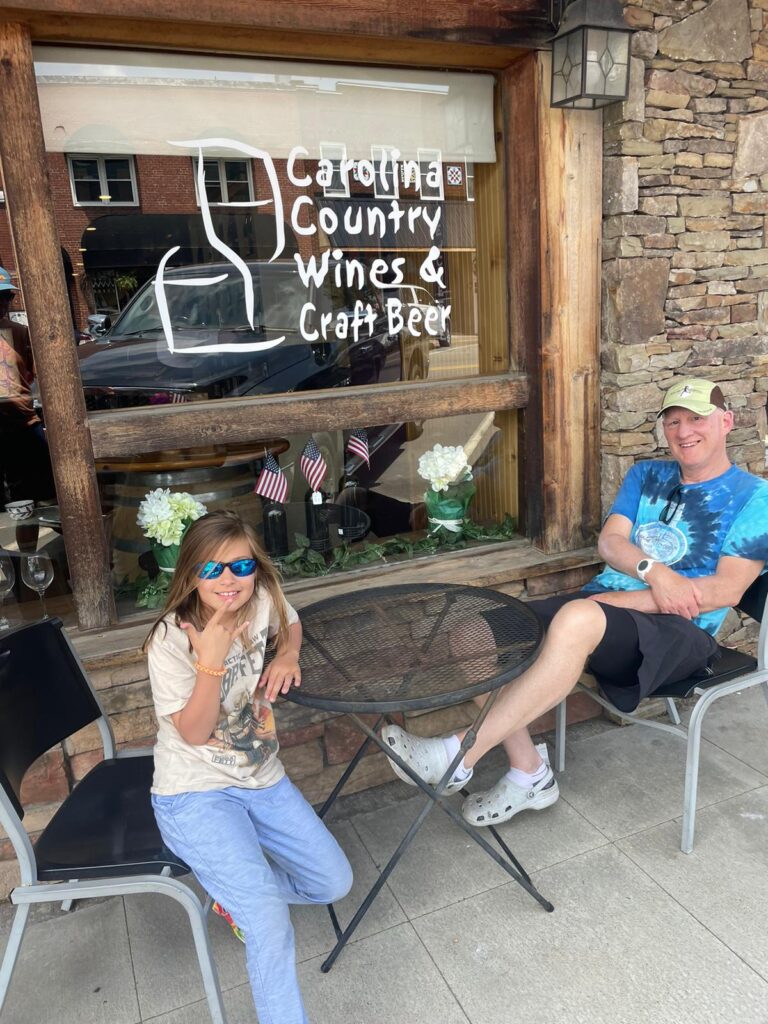
We got you the coolest water shoes ever, and then went to a store where your dad could get some local beers. This is you and me sitting outside that store.
We also found you an excellent ice cream cone of “orange dreamsicle.” Then we went to Wal-Mart. We split into two teams: Team Hot Sauce (David), and Team Worms (you and me). We found our worms immediately:
I think we won the contest.
Then we drove back up to the house, and pretty quickly headed back to the pond. We put a worm on a hook, and pretty soon, you had hooked your first fish – a largemouth bass! You got it to the shore, but you wanted me to hold it while you got the hook out. We did that one just fine.
The second one you caught, you couldn’t get the hook out, so you asked me to get the hook out of it. I was working on the hook, when I felt a hand up on my shoulder. It was you reaching up to grab the hemostat that sits in a magnetic clip on the strap of my fishing bag. You wanted the hook out of the fish, and the critter back in the water right now. I was so proud of you. Pretty quick, I had the hook out (we had squished down the barb of the hook) and the bass was back in the pond.
“Thanks buddy!” you said. My heart leapt with joy.
Ana arrives
Ana arrived that afternoon, after flying out from California. She got lost on the road that runs by our AirBnB, so we were sitting on the porch, talking to her on the phone, and could see her car going back and forth past our driveway. “No Ana, turn around and go back 100 feet!” you said.
Ana finally found her way to the house.
The Pools and the cabin
Our next day was a play date with our cousins, the Pool family. We got to the cabin, and I asked Avery if she could give you a tour. Y’all were out the door and gone. We visited with the Pools a little, and ate some lunch, but then it was creek time!
You and Avery Pool looking for crawdads. You found plenty.
I cannot express how much it meant to me to see you playing in Helton Creek. I played in that same creek, that same place, 60 years ago when I was a kid. And 60 years before that, my grandmother, Mattie Perkins, played in the same creek, in the same place – I’ve seen an old picture of her standing in it with her sister, Clara. That was in the early 1900’s – over 100 years ago. I don’t know this for a fact, but it’s quite possible that her grandmother played in that creek.
Just like my grandmother and her cousins, 110 years ago.
You had such a blast playing in the water, as I knew you would. It was especially fun because the Pool’s dog, Figment, thinks of Helton Creek as his own private swimming pool.
Elena Haupert and Figment Pool living their best lives
After that, we all sat on the bridge and just “visited.” Well, you stayed there for a little while to see if your dad would catch a trout (he did) but then you and Avery disappeared to go explore.
Blueberries
The next day was blueberry picking with the Pools. We drove out to Old Orchard Creek blueberry farm…
If I was a bear, I’d just live here.
We ended up with so many blueberries that we froze them. Then after you left, I made blueberry jam. I still have a few jars of it at our house in San Leandro.
Swimming hole
The next day was your last up in the mountains. The four of us had a quiet morning, and then went to the “swimming hole” on Helton Creek. For two hours, we did nothing – and everything – in the creek. Your dad decided to send a giant log floating down the creek, and spent 20 minutes maneuvering it into position so it would float.
But mostly we just waded around enjoying being in the creek on a warm summer day. At some point, I found a crawdad with just one claw. I lifted it out of the water so you could see it. It was a female, and she was covered with eggs on her underbelly. This blew your mind. You looked at her for a few seconds, then said we had to get her back in the water.
I put her under a rock, and then for the next minute or two, you stood right next to the rock to be sure none of us stepped on her.
Somehow, two hours flew by and we never noticed.
Time to go
The next day, we all drove back to Charlotte. You and your dad flew back to California, while Lisa and I drove up to Asheville to visit a friend.
Elena, I don’t know if you’ll remember much of this trip, but that picture of you playing in Helton Creek is the wallpaper on my computer. And the image is stored in my heart forever.
And somewhere, those old friendly ghosts, my grandmother among them, are smiling. “You got a good ‘un there, Lee,” they’re saying.